Building a private label matcha brand involves much more than selecting a green powder, adding a logo and placing it in an attractive pouch or tin.
A commercially practical matcha product line needs a defined customer, a clear use occasion, a manageable number of products and a realistic connection between quality, packaging, pricing and order volume. Decisions made at the beginning influence almost every later stage, including sample selection, packaging minimums, artwork, production time, inventory requirements and future expansion.
Many new brands begin with packaging ideas before deciding exactly what the product should do. Others try to launch pure matcha, latte blends, flavored products, sachets and accessories at the same time. This may make the range appear complete, but it also creates more packaging components, artwork versions, production minimums and inventory risk before the business has learned what customers actually want.
A stronger private label strategy begins with a simpler question:
What role should matcha play in the brand, and which first product can communicate that role most clearly?
This guide explains how to build a focused private label matcha product line, from positioning and product format to packaging, MOQ planning, supplier communication and commercial launch.
Start with a Product Strategy Rather Than Packaging
Packaging is one of the most visible parts of a private label product, but it should not be the starting point.
Before choosing a pouch color, tin shape or logo position, the brand needs to define who will purchase the product, how they will prepare it and why they should choose it instead of another matcha already on the market.
A premium tea brand may focus on traditional preparation, smooth flavor and a refined drinking experience. A café-oriented business may need a stronger matcha that remains noticeable in milk. A wellness or lifestyle brand may prefer a convenient everyday product with simple instructions, while an online retailer may focus on an accessible matcha for first-time latte drinkers.
These products may all contain matcha, but they should not be developed or marketed in the same way.
A useful starting brief should define the target customer, primary use occasion, expected selling channel and intended price position. “Premium matcha for everyone” is too broad to guide product development. “An easy everyday matcha for first-time home latte drinkers” provides a much clearer direction.
Choose a Realistic Launch Model
A new matcha brand does not need a large product assortment on its first day.
In many cases, a smaller launch makes product positioning clearer, reduces packaging investment and allows the brand to collect meaningful customer feedback before developing additional products.
Product-Line Launch Models
| Launch Model | Recommended Structure | Best Suited For | Main Risk |
|---|---|---|---|
| Hero-product launch | One core matcha product | New brands validating market demand | Limited customer choice |
| Focused collection | Two or three related products | Brands with a defined audience and clear positioning | Higher packaging and inventory requirements |
| Broad assortment | Multiple grades, flavors and formats | Established retailers, distributors or brands with proven demand | Greater cost and operational complexity |
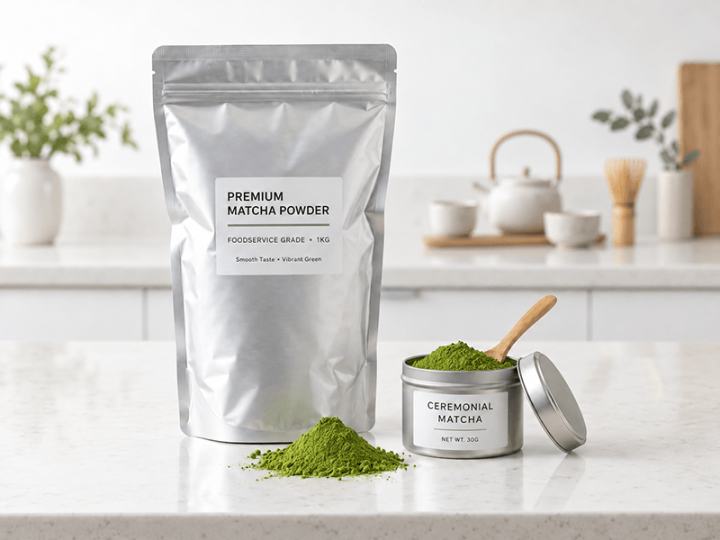
A hero-product launch may consist of one pure matcha powder in a pouch or tin. A focused collection could include one everyday pure matcha and one stronger latte-oriented product. Sachets, flavored blends or larger foodservice packs can then be added after the business has collected sales data.
A broad assortment is more suitable for an established company with multiple sales channels, predictable purchasing volume and sufficient resources to market each SKU properly.
Give Every Product a Clear Role
Every product in the line should answer a different customer need.
Products should not exist only because one package says “premium,” another says “ceremonial” and a third says “daily.” Customers need to understand when to use each product and why they should select one over another.
A focused consumer line might begin with an everyday pure matcha for water and simple lattes, followed by a stronger café-style matcha intended for milk-based drinks. A convenience extension could later introduce portioned sachets for travel or office use.
A café-focused brand might begin with one foodservice pack and one smaller retail pouch that cafés can resell to customers. A wellness brand may instead begin with a pure matcha and add a lightly flavored blend after validating the core product.
The product line should reflect how customers actually shop and prepare matcha rather than trying to cover every possible application at once.
Select the Product Format Before Approving the Matcha
The intended product format changes both the technical requirements and the commercial model.
Pure matcha powder, a sweetened latte blend and a single-serve flavored sachet may all appear under the same brand, but they are different development projects. They require different ingredient decisions, packaging structures, label information and manufacturing processes.
Private Label Matcha Product Formats
| Product Format | Typical Structure | Main Development Considerations |
|---|---|---|
| Pure matcha powder | 100% matcha | Flavor, color, texture, origin positioning and preparation method |
| Matcha latte blend | Matcha with dairy or plant-based ingredients | Mixing, sweetness, allergens and serving size |
| Flavored matcha blend | Matcha with flavors or complementary ingredients | Flavor balance, stability and ingredient declaration |
| Single-serve sachets | Pre-portioned pure matcha or blend | Fill weight, film barrier, packaging MOQ and outer box |
| Foodservice pack | Larger-format matcha powder | Freshness after opening, café usage rate and application strength |
| Ready-to-drink concept | Formulated liquid beverage | Sedimentation, processing, packaging and shelf-life validation |
A matcha that performs well as a pure tea may not remain noticeable after milk, sugar or flavoring is added. A stronger matcha can work well in a latte blend but may be too assertive for a product positioned for traditional drinking.
For this reason, the product format should be confirmed before the final matcha sample is approved.
Build the Line Around Real Customer Use
Each product should be linked to a recognizable customer routine.
A traditional drinking product is designed for customers who value aroma, texture and a more deliberate preparation method. Its packaging may be smaller because the serving size is low and freshness is important.
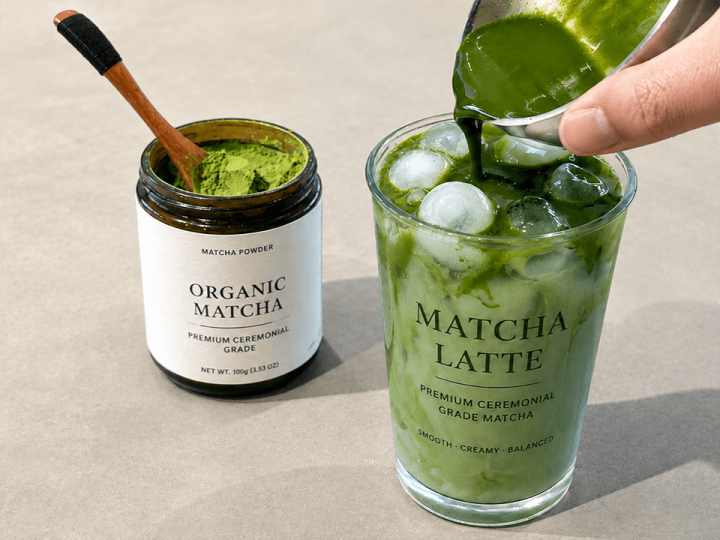
An everyday latte product should be easy to understand and strong enough to remain noticeable after milk is added. Preparation instructions need to give customers a practical amount of matcha, water and milk rather than using vague language such as “add to your favorite drink.”
Single-serve sachets can make dosage more consistent and improve convenience for travel or office use. However, they introduce another packaging system, including inner film, fill weight, box quantity and individual packaging minimums.
Foodservice products need larger packs and may require a stronger application profile. The pack size should reflect how quickly a café will use the product after opening rather than simply maximizing the amount in one bag.
The customer experience should determine the product structure, not the other way around.
Prepare a Detailed Supplier Brief
A supplier cannot recommend the right matcha or estimate the project accurately from a message that only says:
We want to launch a premium matcha brand. Please send your prices.
A useful supplier brief should explain the intended product, customer and commercial conditions. This allows the supplier to recommend relevant samples, identify packaging limitations and provide a more accurate quotation.
Private Label Matcha Project Brief
| Project Area | Information to Provide |
|---|---|
| Target market | Country or region where the product will be sold |
| Target customer | Retail consumers, cafés, distributors or food manufacturers |
| Product format | Pure powder, blend, sachet or foodservice pack |
| Main application | Water, latte, flavored drink, baking or mixed use |
| Product positioning | Entry-level, mainstream, premium or specialty |
| Pack size | Grams per pouch, tin, jar or sachet |
| Expected volume | Initial quantity and estimated annual demand |
| Packaging preference | Pouch, tin, jar, sachet or carton |
| Certification requirements | Organic or other applicable requirements |
| Target price | Intended retail price or target finished-product cost |
| Launch timing | Desired product-ready date |
A complete brief can reveal conflicts before the project becomes expensive.
For example, a brand may want a highly customized tin for a small first order, but the tin manufacturer may require more units than the brand can reasonably sell. The desired retail price may also be incompatible with the selected matcha grade, pack size and packaging system.
Identifying these issues early allows the product structure to be adjusted before samples, artwork and printed components are finalized.
Develop the Product Before Finalizing Artwork
Packaging design often makes the project feel real, so brands are naturally eager to complete it. However, final artwork should not be approved until the product details are stable.
The final formulation affects the ingredient list, serving size and preparation instructions. The pack size affects the net quantity statement and package dimensions. Certification decisions, origin statements and market-specific information may also change the layout.
A more efficient development sequence begins with the product concept and target price. The brand then reviews samples, confirms the product format and chooses the packaging structure. Once the ingredients, fill weight, preparation method and storage conditions are clear, the artwork can be developed and reviewed.
This order reduces repeated design changes and lowers the risk of printing packaging with incorrect or incomplete information.
Evaluate Samples as Complete Branded Products
A sample should not be judged only as dry powder in a bowl.
It should be prepared in the way the final customer is expected to use it. A latte-oriented matcha should be tested with the intended milk. A sachet should be evaluated at the planned fill weight. A pure matcha should be prepared according to the instructions that will appear on the final package.
The question is not simply whether the sample tastes good on its own.
The more important question is whether it creates the experience promised by the brand.
A brand developing an everyday latte product should record the color after milk is added, the strength of the tea flavor, the required dosage and the preparation difficulty. A traditional drinking product should receive more attention for aroma, smoothness and aftertaste.
The sample should also be tested more than once. Preparation should be repeated by different people where possible, because a product that works only under careful development conditions may be difficult for ordinary customers to reproduce.
Once a sample is approved, the brand and supplier should record what was approved. This may include a product code, batch reference, specification or retained sample. Clear approval records reduce confusion when the bulk order enters production.
Decide How Much Customization the Brand Needs
Private label does not always require a completely original formula.
A brand may select an existing matcha grade and customize only the packaging. This can reduce development time and provide a practical route to market.
A second level of customization may involve choosing between several available matcha profiles based on the intended use. A café product may need stronger tea character, while a pure drinking product may need a smoother finish.
More complex projects can involve custom blends, flavors, sweeteners, milk ingredients or single-serve formats. These products may provide stronger differentiation but usually require more sampling, technical review and purchasing commitment.
Maximum customization is not automatically the best strategy. The appropriate level depends on the brand’s sales volume, budget, launch timing and need for differentiation.
A standard matcha in well-designed branded packaging can be a stronger first product than an overcomplicated custom formula launched before the brand has validated demand.
Create a Packaging System for the Whole Range
A successful product line should look like a coordinated family rather than a collection of unrelated packages.
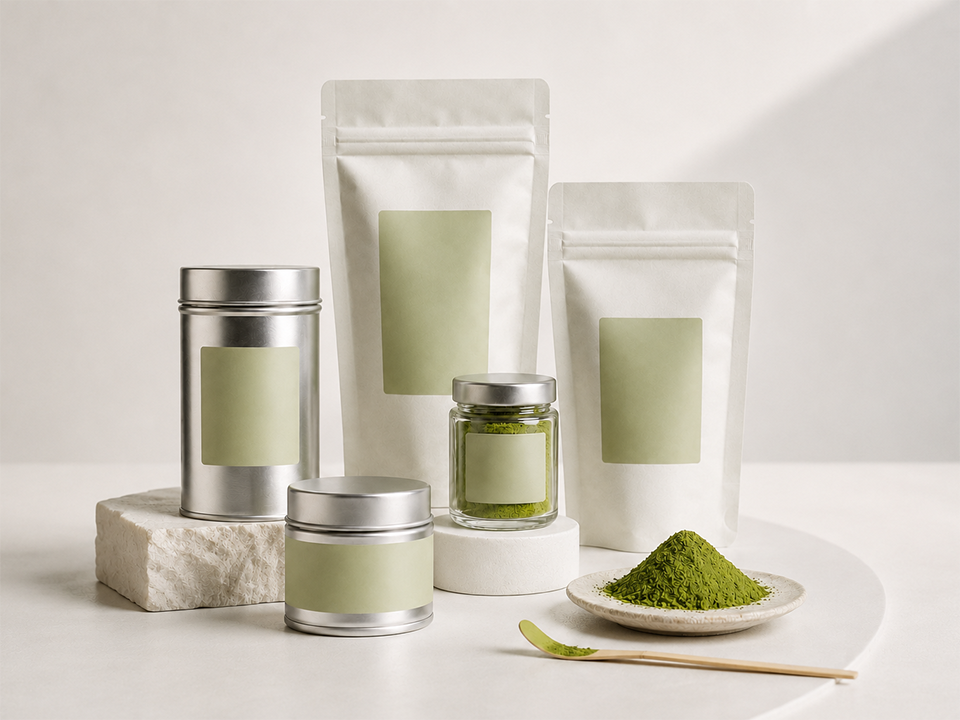
The logo position, typography, visual structure and information hierarchy can remain consistent across the range. Different colors, product names or supporting details can then help customers distinguish pure matcha, latte matcha and flavored products.
The packaging must also protect the product during its expected shelf life and customer usage period. Matcha is sensitive to air, moisture, light and heat, so the packaging structure should be selected according to the product format, pack size and opening frequency.
Packaging and MOQ Planning
| Packaging Option | Main Advantage | MOQ and Planning Considerations |
|---|---|---|
| Stand-up pouch | Lightweight, practical and cost-effective | Custom printing may have a separate minimum for each design |
| Tin | Premium shelf presentation and physical protection | Tin production, labels and filling may have different minimums |
| Jar | Strong retail visibility and reusable appearance | Weight, light protection and shipping cost require review |
| Sachet or stick | Convenient portion control | Film printing and filling usually create higher project minimums |
| Pouch with carton | Stronger retail presentation | Adds another printed component and assembly stage |
| Foodservice bag | Efficient for cafés and high-volume users | Pack size should match the customer’s usage rate |
The most visually impressive packaging is not always the best commercial choice.
A premium tin may support a higher retail price, but it also increases component cost, freight weight and inventory requirements. A stand-up pouch is lighter and more economical but may require stronger graphic design to achieve premium positioning.
The brand should evaluate packaging as part of the complete product model rather than as an isolated design decision.
Understand That MOQ Is Not One Number
A private label matcha project may have several separate minimum quantities.
The supplier may have one minimum for the matcha itself, while the pouch manufacturer has another minimum for custom printing. Tins, jars, sachet films and printed cartons may each be ordered from different production lines with different requirements.
Each artwork design may also be treated as a separate SKU. Launching four pouch colors can therefore require four packaging orders, even when all four products use the same base matcha.
This is one reason that a large first product line can require much more capital than expected.
A phased launch can reduce this risk. The brand can begin with one or two products, use shared components where practical and introduce additional designs only after sales data becomes available.
For example, several products may use the same tin with different labels, or the brand may begin with a printed pouch and introduce sachets after the preferred serving size has been validated.
Calculate the Full Commercial Model
The matcha and packaging quotation represent only part of the final cost.
A realistic commercial model should also include sampling, formulation work, artwork, testing, freight, customs, storage, fulfillment, sales platform fees, retailer margins, promotions and expected product loss.
A product with strong shelf appeal may still be commercially difficult when packaging consumes too much of the target retail price. A low-cost format may protect the margin but require more investment in photography and branding to communicate quality.
The brand should work backward from the expected selling price.
After allowing for distributor, retailer or marketplace margins, the remaining amount must cover the product, packaging, logistics and operating expenses while leaving enough profit to support marketing and future reorders.
This calculation should be completed before the final packaging structure is approved.
Plan Labels and Marketing Claims Carefully
Private label matcha packaging often uses expressions such as premium, ceremonial, organic, natural energy, focus, detox or antioxidant-rich.
These terms should not be treated as decoration.
Some claims may require supporting documentation, certification or market-specific review. Organic claims should only be made when the appropriate product and certification conditions are satisfied. Health and performance claims should accurately reflect the product and available evidence.
A phrase such as “balanced matcha for everyday lattes” describes the intended use and sensory positioning. A claim such as “guaranteed to eliminate brain fog” makes a much stronger promise and creates a different level of substantiation and compliance risk.
The final label should be reviewed for the country where the product will be sold. A design prepared for one market may not automatically meet the requirements of another.
Build Quality Control into the Project
Quality control should begin before production, not after a problem appears.
The approved product, packaging component, fill quantity and artwork version should all be clearly identified. The brand and supplier should also agree on the documents required for the project.
Depending on the market and customer, these may include a product specification, batch Certificate of Analysis, microbiological information, heavy-metal results, pesticide-residue information, allergen statements, GMO statements or relevant certification documents.
The production order should be connected to the approved sample or specification. Packaging should use the correct artwork version, and batch and date coding should follow the agreed format.
The exact quality-control system will depend on the product and sales channel. A small direct-to-consumer launch may require a different supplier qualification process from a national retail or distribution project, but both need a clear record of what was ordered, approved and produced.
Create a Realistic Development Timeline
A private label matcha project includes more than the filling stage.
The process may involve concept development, supplier briefing, sample comparison, formulation revisions, product approval, packaging sourcing, artwork preparation, proof approval, component production, filling, inspection and shipping.
Several stages can overlap, but the product should be sufficiently stable before final artwork is printed.
The launch timeline should also include photography, website preparation, marketplace setup, retailer onboarding and inventory arrival. Production completion does not mean the product is ready for customers.
Custom packaging usually requires more time than standard packaging with a label. Sachets and multi-component retail sets also require more coordination than a single pouch.
A realistic schedule should include revision time rather than assuming every sample and artwork proof will be approved immediately.
Choose a Supplier That Can Support More Than One Order
The lowest powder quotation does not automatically create the strongest private label partnership.
A useful supplier should understand how the product will be used, which matcha profiles suit the application and which packaging structures are commercially practical. The supplier should also communicate clearly about MOQ, production timing, documents and limitations.
Strong technical and commercial feedback is valuable.
A supplier may explain that a delicate matcha will disappear in a sweetened latte blend, that a custom sachet is impractical for a very small trial order or that a proposed package will create a higher minimum than the brand expects.
This type of feedback helps prevent costly mistakes.
The brand should also consider future requirements. A supplier that can support only one current product may become restrictive when the business wants to add foodservice packs, flavored blends or additional markets.
A long-term partner should be able to support product consistency, reorders, new formats and appropriate documentation as the range develops.
Launch the Product Line in Stages
A staged launch gives the brand time to learn before making larger inventory commitments.
The first stage should validate the core product. The brand can monitor sales, customer reviews, preparation questions and reorder behavior. These signals show whether the product positioning is clear and whether customers can achieve the intended result.
The second product should respond to a real need.
Customers may request a larger pack, a stronger latte option, a single-serve format or a flavored extension. Developing a product from actual demand is usually safer than adding a SKU only because competitors offer it.
Once the retail product is established, the brand can consider channel-specific formats such as foodservice bags, wholesale cartons or distributor-ready packaging.
Custom blends, seasonal flavors, accessories and gift sets are better introduced after the core range has stable demand and repeat purchases.
Common Private Label Matcha Mistakes
Launching Too Many Products
A large range may make the brand appear established, but it also divides inventory, purchasing capital and marketing attention across several products.
A focused range is easier to explain, promote and improve.
Finalizing Packaging Before the Product
Changes to the formulation, serving size, ingredient declaration or net weight may require the artwork to be redesigned.
Product details should be confirmed before final printing.
Selecting Matcha Only by Dry Powder Color
Color is important, but the matcha must be tested in its intended application.
A latte matcha should be evaluated with milk. A flavored product should be tested as the full blend. A bright dry powder does not guarantee the best finished product.
Ignoring Packaging Minimums
The product MOQ may be manageable while the custom pouch, tin, sachet film or carton creates the real purchasing requirement.
All component minimums should be confirmed before the range is approved.
Giving Every SKU the Same Product Story
Customers need a clear reason to choose one product over another.
Changing only the package color does not create a meaningful product line.
Making Claims Before Reviewing the Product
Marketing language should reflect the actual formula, available documents and relevant market requirements.
The packaging should not promise more than the product can responsibly deliver.
Comparing Suppliers Only by Price
The final value also depends on the product’s required dosage, packaging support, documentation, communication, production reliability and future consistency.
A lower raw-material price may not result in a lower finished-product cost.
How to Expand a Successful Matcha Line
Scaling does not always mean adding more flavors.
A successful core product can grow through larger packs, subscriptions, improved distribution, café formats or wholesale cartons. These extensions may be easier to manage than introducing several new formulations.
Before adding another SKU, the brand should review customer reorder rates, preparation questions, inventory speed, product margins and channel performance.
Repeated customer questions may indicate that the instructions need improvement rather than a new product. Strong café interest may justify a foodservice pack. Customers purchasing the same product frequently may support a larger size or subscription model.
The next product should solve an identified need and strengthen the existing range.
Frequently Asked Questions
What Is Private Label Matcha?
Private label matcha is matcha powder or a matcha-based product supplied by a manufacturer or ingredient partner and sold under another company’s brand.
The project may use an existing matcha in customized packaging or involve a more customized blend, flavor, serving format or pack size.
How Do I Start a Private Label Matcha Brand?
Begin by defining the customer, main use occasion, sales channel and target price. Select the initial product format, prepare a detailed supplier brief and test suitable samples in the intended application.
Packaging and artwork should be finalized after the product details are confirmed.
How Many Products Should a New Matcha Brand Launch?
Many new brands are better served by one hero product or a focused range of two to three related products.
The appropriate number depends on the available budget, sales channels, packaging minimums and the brand’s ability to market each SKU clearly.
What Matcha Products Can Be Private Labeled?
Common options include pure matcha powder, latte-focused matcha, sweetened blends, flavored matcha, single-serve sachets, foodservice packs and certain formulated beverage or food concepts.
Each format has different development, packaging and minimum-order requirements.
Does a Private Label Matcha Brand Need a Custom Formula?
Not necessarily.
An existing matcha grade with custom packaging can provide a simpler and faster launch. A custom blend or flavor may be appropriate when the brand needs stronger differentiation and can support the additional development work.
What Is the MOQ for Private Label Matcha?
There is no universal MOQ.
The project may involve separate minimums for the matcha, filling, pouch, tin, jar, sachet film, printed carton and each individual artwork design. The complete packaging configuration must be reviewed before the true project minimum is known.
Which Packaging Is Best for Private Label Matcha?
The best format depends on the target customer, sales channel, pack size, brand position and budget.
Pouches are lightweight and practical, tins provide a premium presentation, and sachets offer convenience but usually require more complex production.
Can the Same Matcha Be Sold to Consumers and Cafés?
It is possible, but the packaging and product profile may need to be adjusted.
Consumers generally need smaller packs and clear preparation guidance. Cafés may prefer larger foodservice packaging, stronger milk performance and more detailed batch documentation.
How Long Does a Private Label Matcha Project Take?
The timeline depends on the level of customization, number of sample rounds, packaging structure and shipping method.
Custom packaging, artwork revisions and component production often require more time than new brands initially expect.
What Information Should Be Sent to a Matcha Supplier?
The supplier should receive the product format, intended application, target market, pack size, estimated order quantity, packaging preference, certification needs and desired launch timing.
A complete brief leads to more relevant samples and a more accurate project evaluation.
How Can a Matcha Brand Stand Out?
A strong brand differentiates itself through a clearly defined customer, useful preparation experience, focused product range, credible information and consistent packaging.
Using general words such as “premium” or “ceremonial” is not enough to create a distinctive product strategy.
Final Thoughts
A successful private label matcha product line begins with focus.
The brand needs to understand who the product is for, how the customer will use it and why the first SKU deserves a place in the market. Once those decisions are clear, matcha selection, pack size, packaging and pricing become easier to coordinate.
The strongest launch is not necessarily the one with the most products, the most complicated formula or the most expensive packaging. It is the one that connects a clear product promise with a repeatable customer experience and a realistic commercial model.
Begin with a manageable range. Evaluate samples as complete branded products. Confirm all packaging minimums before approving the assortment, and do not finalize artwork until the product details are stable.
After launch, use customer behavior, reorder data and channel feedback to decide what the product line should become next.
Build Your Private Label Matcha Line with TangMist
TangMist supports private label matcha projects for consumer brands, cafés, beverage businesses, foodservice customers and distributors.
Available options can include pure matcha powder, latte-oriented grades, flavored concepts, retail pouches, tins, sachets and commercial bulk packaging. Each project can be evaluated according to its intended customer, application, pack size, order volume and market positioning.
TangMist can also support application-based sample selection, product specifications, packaging coordination, artwork review, batch documentation and international shipping preparation.
Prepare Your Private Label Project Brief
To evaluate a project efficiently, provide the intended product format, target market, pack size, estimated order volume, packaging preference and desired launch timing.
Contact TangMist to discuss a focused private label matcha product line built around your brand, customers and commercial goals.