Sourcing matcha in bulk involves much more than comparing suppliers and selecting the lowest price.
For international buyers, a successful sourcing decision depends on multiple factors, including product quality, application performance, consistency, food safety requirements, packaging options, export experience, and long-term supply capability.
Different businesses have different expectations for matcha. A café chain may need a powder with vibrant color and balanced flavor that performs well in milk-based beverages. A food manufacturer may focus more on processing performance, stable specifications, and reliable supply. A retail brand may prioritize product positioning, packaging, and consumer experience.
For this reason, companies searching for a reliable bulk matcha supplier should evaluate matcha as both an ingredient and a commercial supply solution.
This guide explains how international buyers can approach bulk matcha sourcing, from defining product requirements and testing samples to evaluating suppliers and building a stable supply relationship.
Start With the Final Matcha Application
The first step in sourcing matcha is understanding how the product will be used.
Different applications require different product characteristics. Matcha that performs well when prepared traditionally may not always be the best choice for commercial beverages, desserts, or food manufacturing.
For example, a premium drinking matcha may have a delicate aroma and smooth flavor when mixed with water. However, those characteristics may become less noticeable when combined with milk, sweeteners, dairy ingredients, or other formulations.
For B2B buyers, the final application should determine the sourcing direction.
Bulk matcha is commonly used in cafés, foodservice operations, beverage products, desserts, bakery products, confectionery, functional food blends, retail products, and private label projects.
| Application | Main Considerations |
|---|---|
| Café Beverages | Color, flavor balance, milk compatibility, and consistency |
| Ice Cream & Desserts | Color stability, tea character, and formulation performance |
| Bakery Products | Flavor intensity, processing performance, and cost efficiency |
| Food Manufacturing | Stable specifications, documentation, and supply reliability |
| Retail Products | Taste, appearance, packaging, and market positioning |
A professional supplier should first understand the customer’s product concept before recommending a matcha option.
Define Matcha Requirements Before Contacting Suppliers
Before requesting a quotation from a wholesale matcha supplier, buyers should prepare clear information about their project.
Many sourcing problems happen because buyers focus on price before defining the actual product requirements.
A useful sourcing inquiry should explain the intended application, target market, estimated purchasing volume, packaging requirements, and any quality or certification expectations.
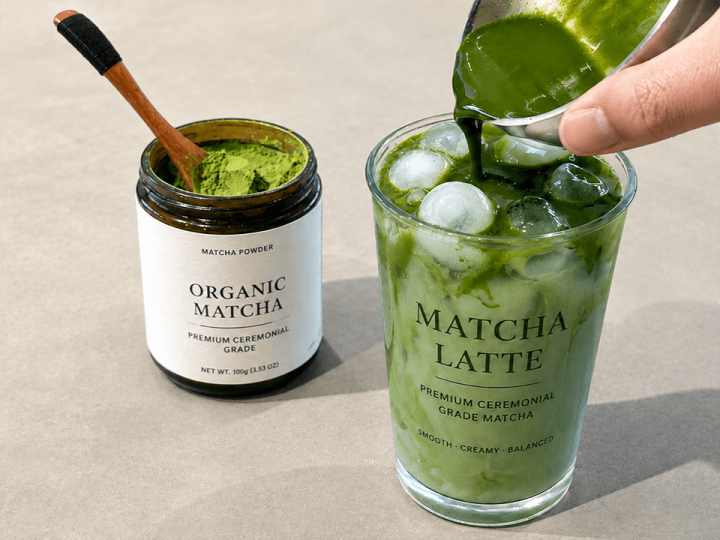
For example, a café group looking for matcha latte powder may prioritize strong color, balanced taste, good performance with milk, and stable repeat supply.
A retail brand developing a premium matcha product may have different priorities, such as flavor profile, packaging format, and product positioning.
Providing this information helps suppliers recommend more suitable options and avoids comparing products that are not designed for the same purpose.
Evaluate Matcha Quality Beyond Marketing Terms
When sourcing bulk matcha powder, buyers should look beyond product names and marketing descriptions.
Terms such as ceremonial, premium, culinary, and food grade are widely used in the market, but they do not always represent identical standards between suppliers.
For commercial purchasing, the actual product performance is more important than the label itself.
Important evaluation factors include color, aroma, flavor profile, texture, particle size, application performance, and batch consistency.
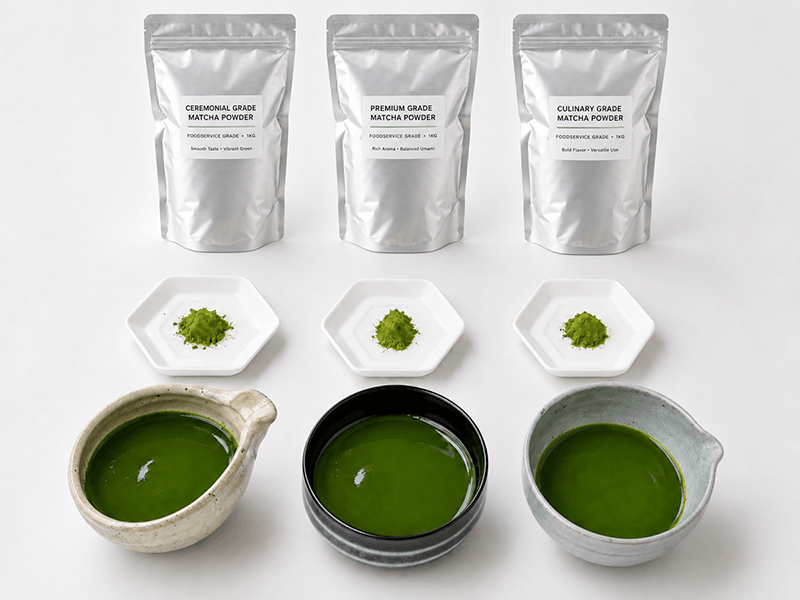
Color and Appearance
Color is one of the first characteristics buyers notice, especially for visually important applications such as matcha lattes, premium beverages, desserts, and retail products.
However, color should be evaluated together with the final application.
A café may require a bright appearance that remains attractive after adding milk.
A food manufacturer may focus more on color stability during processing.
An ice cream producer may evaluate how the color performs after mixing and freezing.
Therefore, the best matcha is not simply the greenest powder, but the one that provides the right visual performance for the intended product.
Flavor Profile
Matcha flavor includes more than bitterness or smoothness.
Professional buyers usually consider overall balance, including tea intensity, umami, sweetness, bitterness, astringency, and aftertaste.
For beverage applications, a stronger tea character may be preferred because the flavor needs to remain noticeable after adding milk or other ingredients.
For premium direct-consumption products, a smoother and more delicate flavor profile may be more suitable.
Texture and Mixing Performance
Particle size and texture can influence mouthfeel, dispersion, and final product appearance.
This is especially important for cafés and beverage manufacturers because poor dispersion or rough texture can affect the customer experience.
Request and Test Samples Before Bulk Ordering
Sample testing is one of the most important steps before placing a commercial matcha order.
Photos, product descriptions, and supplier recommendations can provide useful information, but they cannot fully demonstrate how matcha will perform in the final application.
A café should test samples using its actual recipe, including milk type, sweetness level, serving size, and preparation method.
A food manufacturer should evaluate matcha within the final formulation, such as desserts, bakery products, frozen products, or functional blends.
A retail brand should consider not only taste, but also overall consumer experience and market positioning.
What Should Buyers Evaluate During Sampling?
| Evaluation Area | Key Points |
|---|---|
| Appearance | Color, texture, and powder consistency |
| Aroma | Fresh tea character and overall quality impression |
| Taste | Flavor balance, umami, bitterness, and aftertaste |
| Application Performance | Behavior in the final product formula |
Testing matcha only with water is often not enough for commercial decision-making.
A latte-focused business should evaluate the product in a latte.
A bakery company should test it after processing.
A dessert manufacturer should assess performance after production.
Real application testing provides a more accurate basis for bulk purchasing decisions.
Review Specifications and Quality Documentation
For international buyers, quality documentation is an important part of evaluating a bulk matcha supplier.
Because matcha is consumed as powdered tea leaf, buyers should understand how suppliers manage product specifications, production control, and testing requirements.
Buyers may also consider internationally recognized food safety management systems when evaluating suppliers, such as the standards developed by the International Organization for Standardization (ISO)
The exact documentation required may vary depending on the destination market, product type, and customer standards. Therefore, buyers should confirm requirements with suppliers before placing commercial orders.
Important information may include product specifications, testing reports, traceability information, and other documents required for the target market.
Beyond documentation, buyers should also pay attention to whether the supplier can maintain consistent quality between different production batches.
For businesses purchasing repeatedly, consistency in color, flavor, texture, and overall performance is often more valuable than selecting the highest-priced product available.
A reliable supplier should have a clear approach to managing product variation and maintaining agreed specifications over time.
Evaluate a Matcha Supplier for Long-Term Cooperation
Choosing a matcha supplier is not only about selecting a product. International sourcing also involves communication, production capability, export experience, packaging support, and long-term cooperation.
A supplier that understands B2B requirements can help buyers reduce uncertainty during product development and commercial purchasing.
Before starting a partnership, buyers should understand whether the supplier can support their business requirements, including suitable product recommendations, sample evaluation, clear specifications, reliable communication, export documentation, packaging options, and future order planning.
The quality of supplier communication is often an important indicator of overall capability. Suppliers that ask detailed questions about application, market, and requirements are usually better positioned to recommend suitable solutions.
Understand MOQ and Packaging Options
Minimum order quantity (MOQ) depends on the matcha specification, packaging format, customization requirements, and purchasing volume.
Different types of buyers usually require different packaging solutions.
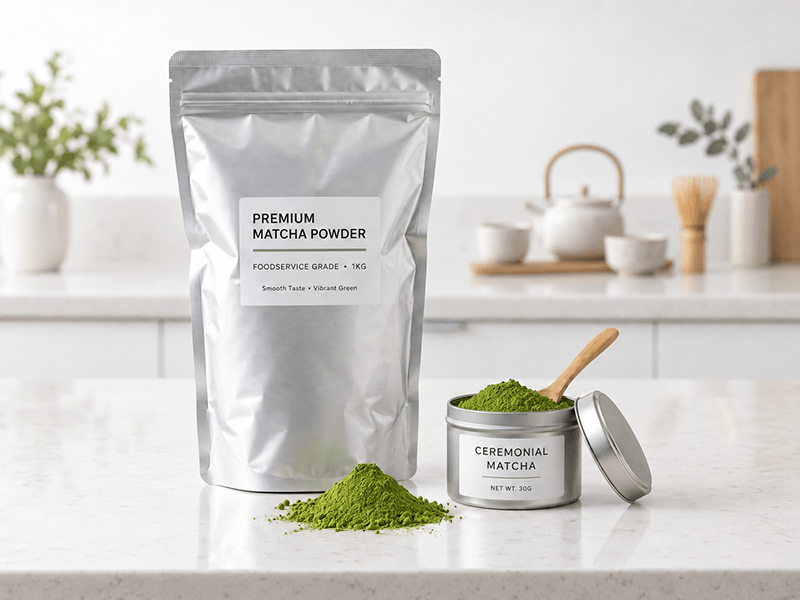
Cafés, foodservice businesses, distributors, and manufacturers often purchase matcha in bulk formats designed for operational use. Larger packaging options can help improve handling efficiency and reduce unnecessary packaging costs.
Retail brands and private label companies usually require smaller consumer-facing formats that support branding and market presentation.
Common packaging considerations include:
- Product usage frequency
- Storage conditions
- Shipping requirements
- Sales channel
- Consumer positioning
The right packaging format should match both the product application and the business model.
For example, foodservice customers may prioritize practical bulk bags, while retail brands may focus more on packaging appearance, convenience, and shelf presentation.
Consider Private Label Matcha Requirements
Some international buyers are not only sourcing matcha as a raw ingredient. They are developing a finished branded product.
For these projects, a private label matcha supplier may need to support product selection, packaging coordination, labeling requirements, and production planning.
The sourcing approach depends on the target market.
A premium retail brand may focus on product presentation, flavor profile, and consumer perception.
An e-commerce business may prioritize lightweight packaging and efficient shipping.
A distributor may require different product formats to serve multiple customer groups.
For this reason, private label projects should consider matcha selection, packaging, and market positioning together rather than treating them as separate decisions.
Build a Reliable Long-Term Matcha Supply Relationship
For many international buyers, matcha sourcing is not a one-time transaction.
As businesses grow, purchasing requirements may change. A small café brand may later require larger volumes, additional product options, or different packaging formats. A distributor may need a wider range of matcha solutions for different customers.
A reliable supplier should be able to support long-term cooperation through stable product quality, consistent specifications, responsive communication, and flexible production planning.
For commercial buyers, supply reliability becomes especially important because changes in matcha quality can affect:
- Product consistency
- Customer experience
- Recipe performance
- Brand reputation
A strong supplier relationship allows businesses to plan future growth with greater confidence.
Common Mistakes When Sourcing Matcha in Bulk
Many sourcing issues can be avoided by understanding the most common mistakes made by international buyers.
One common mistake is choosing matcha only by grade name. Since grading terminology is not always standardized, buyers should evaluate actual product performance rather than relying only on labels.
Another mistake is focusing only on color. While vibrant green color is important for many applications, it does not represent the complete quality profile. Flavor, freshness, consistency, and application performance should also be considered.
Some buyers also skip application testing and approve samples based only on simple preparation with water. This can create problems when the matcha is later used in beverages, desserts, or food products.
Finally, selecting the lowest price without considering total value can lead to issues such as inconsistent quality, higher dosage requirements, or supply problems.
Information Buyers Should Prepare Before Requesting a Matcha Quote
Before contacting a matcha supplier, international buyers can prepare several key details to make the sourcing process more efficient.
| Information | Why It Matters |
|---|---|
| Intended Application | Helps determine suitable matcha characteristics |
| Target Market | Helps understand product requirements and documentation needs |
| Estimated Volume | Supports pricing and production planning |
| Packaging Requirements | Helps recommend suitable formats |
| Quality Expectations | Helps select appropriate samples |
| Certification Requirements | Ensures compatibility with the target market |
Providing clear project information allows suppliers to better understand the business objective and recommend suitable matcha solutions.
Frequently Asked Questions About Bulk Matcha
What is the best matcha for cafés?
There is no single matcha product that is suitable for every café.
Many cafés select beverage-focused matcha because it provides a balance between color, flavor intensity, smoothness, and commercial practicality.
The final selection should be based on actual recipe testing, including milk type, sweetness level, serving size, and preparation method.
How should businesses choose a bulk matcha supplier?
Businesses should evaluate suppliers based on product quality, consistency, documentation, communication, packaging capability, export experience, and long-term supply support.
A suitable supplier should understand both the matcha itself and the commercial requirements behind the project.
Should buyers test matcha samples before bulk purchasing?
Yes.
Sample testing helps buyers understand how matcha performs before committing to larger quantities.
Testing should ideally be completed using the final application rather than only evaluating the powder with water.
What packaging options are available for bulk matcha?
Packaging depends on the buyer’s application and sales channel.
Foodservice and manufacturing customers typically require practical bulk formats, while retail and private label products usually require consumer-oriented packaging designed for branding and distribution.
Conclusion: Choosing the Right Bulk Matcha Supplier
Sourcing matcha in bulk requires a broader evaluation than simply comparing price per kilogram.
International buyers should consider the intended application, product performance, sample results, quality requirements, packaging options, supplier capability, and long-term consistency.
The right bulk matcha supplier should provide not only suitable matcha products, but also reliable support throughout the sourcing process.
TangMist works with international cafés, food brands, distributors, foodservice businesses, and private label companies seeking matcha solutions for different commercial applications.
Whether a business is developing a matcha beverage program, sourcing matcha for food production, expanding a wholesale product range, or creating a retail matcha line, the sourcing process should begin with understanding the final product requirements.
Looking for a Reliable Bulk Matcha Supplier?
TangMist supports international B2B buyers with matcha solutions for cafés, foodservice applications, wholesale distribution, retail products, and private label projects.
Businesses can share their application, target market, expected volume, and packaging requirements with TangMist to discuss suitable matcha options and sample evaluation.
Contact TangMist to start your bulk matcha sourcing project.