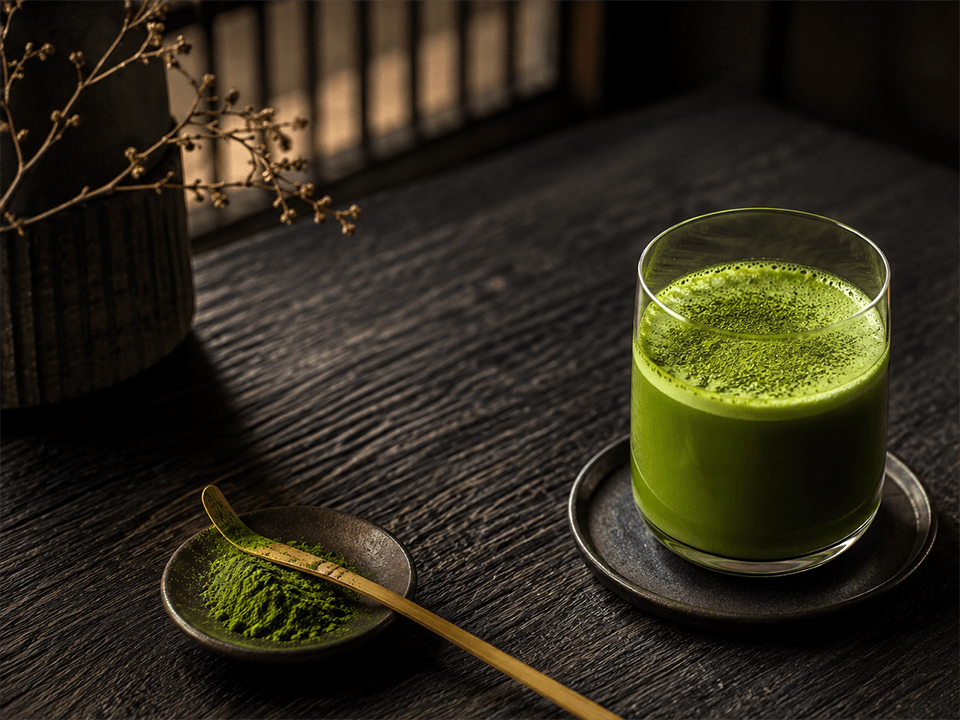
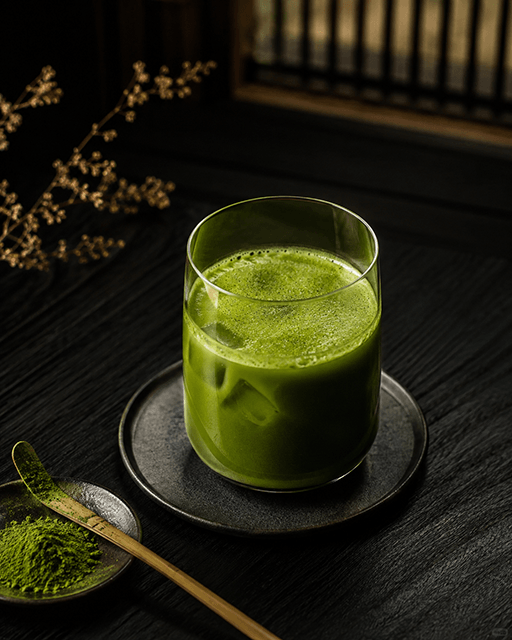
Matcha is valued commercially for its recognizable green appearance.
A bright matcha latte can communicate freshness and premium quality before the customer takes the first sip. Green color also plays an important role in matcha ice cream, chocolate, bakery products, sachets and ready-to-drink beverages.
That color is not permanently stable.
Matcha may gradually become dull, yellow-green, olive, gray-green or brown after it is heated, mixed with acidic ingredients, exposed to air, stored under light or kept too long under unsuitable conditions.
For cafés, this may happen within a prepared drink or an open service container. For manufacturers, color loss may appear during pasteurization, baking, frozen storage or shelf-life testing. For distributors and private label brands, the powder may arrive green but become less attractive after repeated exposure to air and humidity.
The problem is often described simply as oxidation. Oxidation is important, but it is not the only explanation.
Matcha color is influenced by its initial pigment profile, processing history, heat exposure, pH, oxygen, light, moisture, storage temperature, packaging and the other ingredients in the formula.
Understanding these factors helps businesses answer a more useful question:
Is the color problem coming from the matcha itself, the product formula, the processing method, the packaging or the storage conditions?
This guide explains why matcha turns brown, how the seven main factors interact and how commercial buyers can evaluate color stability before approving a bulk ingredient or finished product.
What Gives Matcha Its Green Color?
The green appearance of matcha is primarily associated with chlorophyll pigments in the tea material.
A 2024 peer-reviewed matcha study summarized by the USDA Agricultural Research Service found a close relationship between measured matcha color indicators and chlorophyll content. The researchers also noted that chlorophyll is unstable when exposed to oxygen, heat and light during matcha production and storage.
Matcha does not contain only one green pigment or one chemical component. Its final appearance reflects chlorophylls, pigment derivatives, particle characteristics, raw-material quality and the way light interacts with the fine powder.
This is why two matcha samples with similar total chlorophyll content may still look different to the human eye.
The starting color can also be affected before the powder reaches the buyer. Tencha processing changes chlorophyll composition, and researchers have developed near-infrared methods specifically to monitor chlorophyll a, chlorophyll b and total chlorophyll during tencha production.
Commercial color stability therefore begins with the incoming ingredient, but it does not end there.
Why Green Matcha Becomes Olive or Brown
One important pathway involves the conversion of chlorophyll into less vividly green derivatives.
Under acidic conditions or heat, the magnesium ion at the center of the chlorophyll molecule can be lost. This process produces pheophytin-related pigments, which are generally associated with more olive-green or brownish tones.
A detailed analysis of chlorophylls in green teas found that pheophytins form readily from chlorophylls under acidic conditions. The study also identified meaningful differences in chlorophyll and chlorophyll-derivative profiles among matcha and other green teas.
More intense heating can continue the degradation process. Research on green tea powder found that mild microwave treatment promoted magnesium loss and the formation of chlorophyll derivatives, while stronger treatment caused further chlorophyll degradation, catechin-related changes and, under severe conditions, reactions associated with brown and yellow color development.
The final brown appearance is therefore not necessarily caused by one single reaction.
It may reflect chlorophyll degradation, oxidation of tea polyphenols, formation of olive-colored pigment derivatives, thermal reactions and visual dilution by other ingredients.
The Seven Critical Factors at a Glance
| Critical Factor | How It Affects Matcha Color | Common Commercial Situation | Main Control Approach |
|---|---|---|---|
| 1. Starting matcha quality | Determines the initial pigment profile and color potential | A dull incoming powder cannot create a naturally vivid finished product | Approve the ingredient in the actual application |
| 2. Heat and exposure time | Accelerates chlorophyll conversion and pigment degradation | Pasteurization, baking, hot holding and repeated reheating | Reduce unnecessary heat load and test the complete process |
| 3. Acidity and pH | Acidic conditions promote conversion of green chlorophyll into olive-colored derivatives | Fruit drinks, yogurt products, citrus formulas and acidified RTD beverages | Measure the final formula pH and run controlled trials |
| 4. Oxygen exposure | Supports oxidative reactions affecting pigments and polyphenols | Open bags, large headspace, vigorous mixing and partially filled containers | Limit repeated air exposure and use appropriate packaging |
| 5. Light exposure | Can promote photochemical degradation and fading | Transparent jars, retail display lighting and clear bottles | Use opaque or light-barrier packaging |
| 6. Moisture and humidity | Increases chemical mobility and can accelerate deterioration | Humid production rooms, condensation and poorly resealed powder | Keep the powder dry and control opening procedures |
| 7. Storage temperature, time and packaging | Determines how quickly several degradation pathways continue | Long warehouse storage, warm transport and slow product turnover | Use suitable barrier packs, controlled storage and realistic shelf-life testing |
These factors rarely act independently.
For example, a clear bottle may expose a matcha beverage to light while its headspace provides oxygen and warm retail storage increases the reaction rate. A fruit-based formula may combine acidity, oxygen and heat processing at the same time.
The practical objective is therefore to control the complete product system rather than searching for one universal solution.
1. Starting Matcha Quality and Pigment Profile
Color stability cannot be separated from the starting matcha.
A powder that begins with a dull yellow-green or gray-green appearance has less visual margin for heat, dilution and storage. Even a carefully designed recipe cannot restore pigment quality that was not present in the incoming ingredient.
However, starting quality should not be judged from supplier photographs alone.
Studio lighting, camera exposure, editing, monitor settings and powder thickness can make a sample appear brighter than it does under normal conditions. The buyer should compare physical samples using equal quantities, identical containers and controlled lighting.
The samples should then be tested in the finished application.
A vivid dry powder may become weak after it is mixed into milk. Another powder may look slightly deeper in the sample bowl but maintain a more recognizable green in an oat milk latte or frozen dessert.
Grade Names Do Not Predict Color Stability
Terms such as ceremonial, premium, café and culinary do not guarantee a particular chlorophyll content or processing performance.
A high-priced drinking matcha may provide excellent aroma and smoothness in water but offer limited advantage after baking. A commercially selected culinary matcha may produce stronger finished color in ice cream, white chocolate or sweetened drinks.
The supplier’s grade name should guide sample selection, not replace testing.
The approved matcha should be connected to a supplier product code, physical reference sample and written specification.
Harvest and Processing Matter
The pigment profile is influenced by the tea material and the way it is processed.
Research monitoring tencha production has shown that chlorophyll content changes during processing and can be measured as a meaningful quality parameter.
This does not mean that the buyer must specify one universal chlorophyll value for every application.
Instrumental pigment data can support quality control, but the finished product still determines whether the color is commercially suitable.
2. Heat Intensity and Exposure Time
Heat is one of the most important causes of matcha color loss in commercial products.
Chlorophyll-related changes generally increase as the thermal load becomes more severe. Thermal load includes both temperature and duration.
A short preparation with warm water is different from prolonged hot holding. Baking is different from pasteurization. Reheating a beverage several times may create a different result from one controlled processing step.
Research on green tea powder under microwave treatment found that green color declined as heating intensity and exposure time increased. Mild treatment was associated with chlorophyll magnesium loss and derivative formation, while severe treatment produced much greater chlorophyll degradation and brownish-yellow color.
A separate matcha storage study also connected higher storage temperature with reduced greenness and declining chlorophyll content over time.
Hot Water Does Not Automatically Ruin Matcha
It would be inaccurate to conclude that all warm preparation immediately turns matcha brown.
The outcome depends on the temperature, exposure time, matcha, water chemistry and intended sensory result.
A freshly prepared café drink may remain visually acceptable even when warm water is used. The greater risk often appears when the product is kept hot for an extended period, repeatedly heated or subjected to industrial processing.
The business should test the actual method rather than relying on a universal statement that matcha must never contact hot water.
Baking Creates Several Color Challenges
In bakery products, matcha is exposed to heat while interacting with flour, sugar, fat, eggs, leavening agents and moisture.
Color loss may come from chlorophyll degradation, dilution within the batter and browning reactions in the surrounding food matrix.
The color of raw dough or batter is therefore not a reliable prediction of the finished product.
Matcha selected for cookies, cake, bread or fillings should be evaluated after normal baking and cooling. When shelf life matters, the color should be checked again after storage.
Ready-to-Drink Processing Requires Full Validation
Pasteurized or shelf-stable matcha beverages present a more difficult challenge than freshly prepared drinks.
The product may combine heat, water, oxygen, storage time and other ingredients. A bright benchtop formula can therefore become dull after the real production process.
The final thermal schedule should be developed according to food-safety requirements by qualified technical teams. Matcha color cannot be protected by reducing a validated safety process without proper reformulation and process review.
3. Acidity and pH
Acidic conditions can cause green chlorophyll to shift toward more olive-colored derivatives.
The mechanism is related to the loss of magnesium from the chlorophyll structure. Analytical work on green tea pigments has identified pheophytin formation under acidic conditions and documented the presence of these pigment derivatives in processed teas.
This factor is especially important in fruit-flavored matcha products.
Lemon, passion fruit, berry, pomegranate and other acidic ingredients may create appealing flavor combinations while reducing green color stability. Citric acid, acidified flavor systems and cultured dairy ingredients can have similar effects.
Measure the Finished Formula, Not One Ingredient
The supplier’s matcha specification cannot predict the pH of the final product.
The complete formula should be measured after all ingredients have been added and after any processing step that may change the system.
A fruit syrup may have a low pH, but the final drink pH depends on the syrup dose, water, milk, buffers and other ingredients.
The same formulation should also be checked during shelf-life work, because product chemistry can continue changing after filling.
Do Not Add Alkali Casually
A more alkaline environment may appear to preserve a greener chlorophyll appearance, but increasing pH is not a simple commercial solution.
Alkaline ingredients can change flavor, mouthfeel, texture, leavening behavior and regulatory declarations. Excessive alkalinity may also create an unnatural color or soapy taste.
Any pH adjustment should be developed as part of the complete food formulation and validated for safety, sensory quality and legal suitability.
Fruit Matcha May Require a Different Visual Standard
A fruit-flavored matcha beverage may not remain the same deep green as a traditional water-based matcha.
That does not automatically mean the product has failed.
The business should define an achievable color target that is consistent with the formula. A natural, slightly muted green may be more realistic than a highly vivid color that can only be achieved through major formulation changes or added colorants.
4. Oxygen Exposure
Oxygen can contribute to the deterioration of matcha pigments and other tea components.
The USDA summary of a 2024 matcha color study identifies oxygen, heat and light as important sources of chlorophyll instability during production and storage.
Oxygen exposure occurs in several ways.
A bulk bag may be opened repeatedly during café service. A partially empty container may contain a large volume of air above the powder. A beverage may incorporate air during high-speed mixing. A bottle may retain oxygen in its headspace or dissolved in the liquid.
The visual impact may develop gradually rather than immediately.
A drink that appears green after preparation may become dull during holding. Open powder may lose brightness over days or weeks, especially when combined with heat, humidity and light.
Vigorous Mixing Can Create a Trade-Off
Strong mixing may improve dispersion but can also introduce air into the product.
This does not mean that commercial products should avoid proper mixing. Poor dispersion creates clumps, uneven flavor and inconsistent color.
The objective is to use enough mixing to achieve the required texture without introducing unnecessary air or extending mixing beyond the validated method.
For ready-to-drink products, oxygen management may involve equipment design, deaeration, filling conditions, headspace control and packaging. These decisions require application-specific engineering rather than a general home-kitchen rule.
Large Bulk Packs May Increase Repeated Exposure
A café using one large matcha bag over a long period repeatedly introduces fresh air each time the package is opened.
Smaller inner packs may reduce the exposure experienced by the total inventory. They can also make stock rotation and service handling easier.
The correct pack size depends on daily consumption, storage conditions and cost. A small pack that is consumed quickly may protect quality better than a large economical bag that remains open for several months.
5. Light Exposure
Light can promote pigment deterioration and reduce the visual quality of matcha.
Chlorophyll interacts strongly with light, and matcha research identifies light exposure as a contributor to instability during storage.
A 2026 study specifically examined the combined effects of water activity and light exposure on the degradation and storage stability of major compounds in matcha powder. Its design reflects an important commercial reality: light damage is often influenced by the moisture condition of the product rather than occurring in isolation.
Transparent packaging may therefore create a disadvantage even when it allows customers to see the powder.
Retail Display Conditions Matter
A product may remain acceptable in a warehouse but deteriorate faster under strong retail lighting or direct sunlight.
Display testing should reflect the actual sales environment.
When a clear window is important for packaging design, the business should determine whether the visual benefit justifies the additional exposure. A small window may be less damaging than a completely transparent package, but the result still needs testing.
Prepared Drinks Are Also Light-Sensitive
A clear bottle or cup allows the customer to see the matcha, which can be commercially attractive.
It also exposes the drink to ambient and display light.
For a freshly prepared café drink consumed quickly, this may be acceptable. For a refrigerated ready-to-drink product stored for weeks or months, light protection can become much more important.
Package design should therefore be based on the expected holding period rather than appearance alone.
6. Moisture and Humidity
Dry matcha is more stable than a high-moisture beverage, but the powder can still absorb moisture from humid air.
Moisture increases molecular mobility and can accelerate several deterioration reactions. It may also cause clumping, reduce flow and make the powder harder to measure consistently.
The 2026 matcha storage study examining water activity and light exposure reinforces the importance of controlling both moisture status and environmental exposure during storage.
Humid Service Areas Increase Risk
Cafés often store matcha close to sinks, steam wands, ice machines or hot beverage equipment.
Opening the package in this environment can expose the powder to humid air. Wet scoops and spoons create an even more direct moisture risk.
The active-use container should be kept dry, closed between uses and handled only with clean, dry equipment.
Refrigeration Can Create Condensation Problems
Cold storage may help slow deterioration, but opening a cold package in warm, humid air can allow condensation to form.
Businesses using chilled or frozen inventory should establish a handling procedure.
A sealed pack should generally be allowed to approach the working environment before opening when condensation is a concern. The exact procedure should reflect the package size, storage method and production environment.
Repeated movement of the same large pack between cold and warm conditions may be less effective than dividing inventory into smaller sealed units.
Moisture Can Affect Safety as Well as Color
Color change alone cannot determine whether matcha is safe or unsafe.
A brown product may have experienced pigment degradation without microbiological spoilage. Conversely, a powder that still looks green should not be considered safe when it has been contaminated or stored improperly.
When moisture exposure is suspected, the material should be evaluated according to the company’s food-safety and quality procedures rather than approved by color alone.
7. Storage Temperature, Time and Packaging
Time allows the effects of heat, oxygen, light and moisture to accumulate.
Even well-produced matcha does not remain visually identical forever.
A controlled matcha study followed color changes during two months of storage and found that higher storage temperatures were associated with reduced green color, declining chlorophyll and greater overall color change.
A separate study of green tea stored for twelve months found substantially better sensory color retention under low-temperature storage than at room temperature or elevated temperature. Although that work studied green tea rather than every commercial matcha format, it supports the broader importance of storage temperature for green tea quality.
Packaging Must Control More Than One Risk
An effective matcha package should be evaluated for oxygen, moisture and light protection.
A visually attractive paper pouch may need an internal high-barrier layer. A metal tin may block light but still depend on the inner seal and closure system for air and moisture protection. A resealable pouch may work well only when staff close it correctly.
The package should also withstand transport and normal handling.
Material specifications, seal quality and package dimensions should be agreed before commercial production.
Shelf Life Should Be Based on Evidence
A printed shelf life should not be selected only because a competitor uses the same period.
The appropriate period depends on the matcha, packaging, storage conditions, destination market and acceptance criteria.
A supplier may provide a general shelf-life recommendation for bulk powder. A finished beverage or food product still requires its own stability and shelf-life assessment.
The manufacturer should establish what level of color change remains acceptable and confirm that food-safety, flavor and other quality requirements are met throughout the intended period.
How Different Matcha Products Lose Color
The seven factors appear differently across applications.
| Commercial Application | Typical Color Problem | Likely Contributing Factors | Most Useful Development Test |
|---|---|---|---|
| Open bulk matcha powder | Powder becomes dull, yellow-green or gray-green | Oxygen, light, humidity, warm storage and repeated opening | Compare newly opened and active-use packs under controlled light |
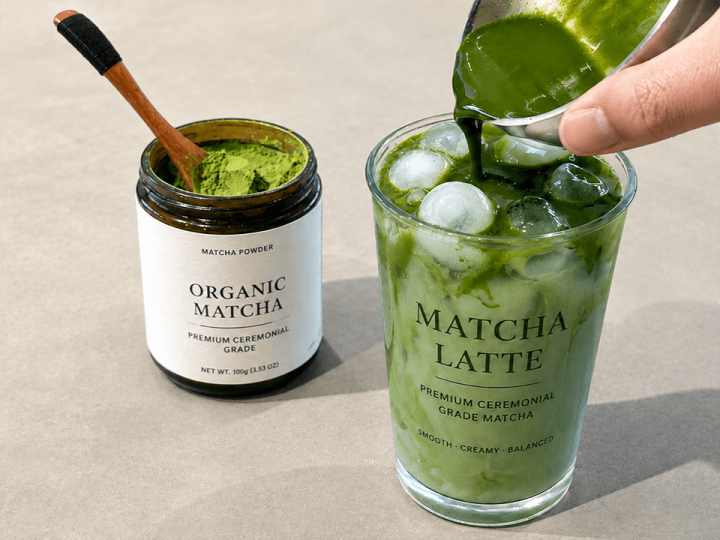
| Hot matcha latte | Green becomes muted or olive | Heat, milk dilution and holding time | Evaluate immediately and after realistic service holding |
| Iced matcha latte | Drink appears pale or separates | Low dosage, milk dilution, settling and long serving time | Test color after ice dilution and thirty to sixty minutes |
| Fruit-flavored matcha | Green changes quickly or becomes muddy | Low pH, fruit color, oxygen and ingredient interactions | Measure final pH and compare several complete formulas |
| Ready-to-drink beverage | Color fades during shelf life | Heat processing, oxygen, light, formula pH and storage time | Run pilot processing and formal stability testing |
| Bakery product | Batter is green but final product is brown | High heat, long baking, Maillard browning and pigment dilution | Evaluate after baking, cooling and storage |
| Matcha ice cream | Product is pale or dull after freezing | Milk and fat dilution, storage, air incorporation and ingredient ratio | Compare finished frozen product rather than liquid mix |
| Matcha chocolate | Green appears yellow or muted | Cocoa butter color, heat, matcha dosage and storage | Evaluate after tempering and final crystallization |
The same symptom can have several causes.
A pale oat milk latte may not involve chlorophyll degradation at all. It may simply contain too little matcha relative to the milk volume.
A brown baked cookie, by contrast, may reflect both matcha pigment loss and normal browning of the surrounding ingredients.
Diagnosis should begin with the complete production history.
Why More Matcha Does Not Always Solve the Problem
Increasing the matcha dosage can deepen the initial color, but it does not necessarily improve stability.
More powder may also increase bitterness, astringency, ingredient cost and sedimentation. When heat, acidity or oxygen is the main cause, the additional pigment may still degrade during processing or storage.
A dosage adjustment should therefore be treated as one controlled development variable.
The business should compare color, flavor and cost at several measured inclusion levels while keeping the rest of the formula constant.
The lowest dosage that meets the finished-product standard is generally more useful than the dosage that creates the darkest raw mixture.
Why a More Expensive Matcha May Still Turn Brown
Premium raw material cannot eliminate the effects of processing chemistry.
A vivid matcha may begin with more attractive color potential, but chlorophyll remains sensitive to heat, acidic conditions, oxygen and light.
Using a higher-priced matcha in a strongly acidic or heavily heated product may therefore increase ingredient cost without producing stable color.
Commercial buyers should compare multiple application-relevant samples after the full process.
For bakery, ready-to-drink and flavored beverage projects, an application-focused grade may outperform a delicate drinking grade even when its dry powder looks slightly less impressive.
How to Diagnose the Cause of Brown Matcha
The timing of the color change provides useful evidence.
When the incoming dry powder is already dull, the issue may involve the product grade, production history or previous storage.
When the matcha turns olive immediately after adding a fruit ingredient, pH is a likely contributor.
When the drink is initially bright but becomes dull during holding, oxygen, light, settling and time should be investigated.
When color loss appears only after baking or pasteurization, thermal exposure is probably important.
When several opened bags deteriorate faster during humid weather, moisture and handling practices deserve attention.
This type of pattern analysis cannot prove the mechanism by itself, but it helps the development team design a smaller and more informative test programme.
Build a Commercial Color Stability Test
Color testing should reproduce the intended product rather than studying dry powder alone.
Example Matcha Color Stability Test Plan
| Test Stage | Controlled Variables | Evaluation Timing | What to Record |
|---|---|---|---|
| Incoming powder | Equal sample weight, container and lighting | On receipt and after opening | Dry color, aroma, clumping, code and batch |
| Water baseline | Matcha weight, water volume, temperature and mixing | Immediately after preparation | Green intensity, hue, bitterness and texture |
| Final formula | All ingredients, dosage and mixing order | Immediately after preparation | Finished color, flavor and ingredient interactions |
| Processing test | Exact heat, cooling, freezing or baking conditions | Before and after processing | Color change caused by production |
| Holding test | Cup, bottle, light and temperature | At defined intervals | Fading, settling, separation and foam changes |
| Packaging test | Package material, seal and headspace | During planned storage | Effect of oxygen, moisture and light protection |
| Shelf-life test | Defined storage temperatures and conditions | Throughout the intended period | Visual color, instrumental values, flavor and safety criteria |
| Pilot batch confirmation | Commercial equipment and normal production volume | Before release and after storage | Whether laboratory results transfer to production |
Only one main variable should be changed at a time during early development.
For example, the team can compare several pH levels while keeping the matcha, heat process and packaging constant. It can then test two packaging structures after the preferred formula has been selected.
Changing matcha grade, dosage, pH, process and package at the same time makes the result difficult to interpret.
Use Instrumental Color Measurement Where Necessary
Human visual comparison is useful, especially when the product is ultimately purchased by consumers.
However, lighting, background and evaluator expectations can make visual judgments inconsistent.
Commercial teams can supplement visual inspection with CIE L*a*b* measurements. In this system, L* represents lightness, while a* and b* describe opposing color directions. For green products, movement in the a* value can help track loss of greenness.
The 2024 matcha color study used instrumental color indicators together with chlorophyll measurements and demonstrated strong relationships between matcha color and pigment content.
Instrumental measurements should not be interpreted without context.
A numerical difference may be statistically detectable but not commercially visible. The buyer should define an acceptable range using both product measurements and sensory approval.
Establish a Finished-Product Color Standard
The dry matcha standard is not enough for a commercial formula.
A café can establish a controlled reference latte using the approved matcha, dosage, milk, cup and lighting. A manufacturer can retain reference photographs and instrumental values from the approved pilot batch.
The standard should reflect realistic natural variation.
It should not require every agricultural batch to produce identical digital color values under all conditions.
The purpose is to identify meaningful deviations that affect brand presentation or customer acceptance.
The standard should also specify when the color is evaluated. An iced beverage immediately after mixing may not look the same after thirty minutes, and both points may be relevant to the customer experience.
Packaging Strategies for Bulk Matcha
Bulk buyers should select packaging according to their rate of use.
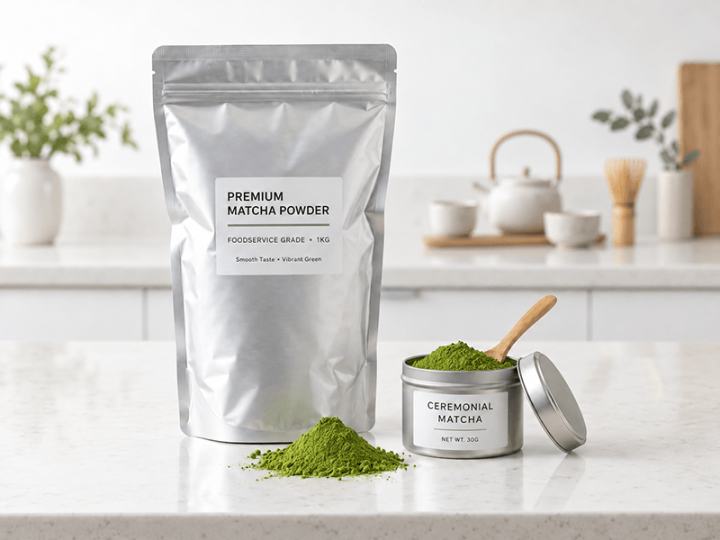
A food manufacturer consuming an entire five-kilogram inner bag during one production run has different needs from a café using the same quantity gradually over several months.
For slow consumption, several smaller inner bags can reduce repeated exposure of the remaining inventory. The outer carton can provide physical protection, while the inner packaging supplies the main moisture, oxygen and light barrier.
The buyer should confirm the packaging material, unit weight, seal method, carton configuration and storage instructions.
After opening, the business should transfer only enough powder for the active working period and keep the remaining stock sealed.
Packaging Strategies for Finished Products
Finished-product packaging should be selected after the formula and process have been established.
An opaque package can reduce light exposure, but it does not automatically control oxygen. A strong oxygen barrier does not compensate for a poor seal. A resealable closure does not protect the product when users leave it open.
For bottled beverages, the package must also fit the filling and heat process.
For retail matcha powder, small tins or barrier pouches may protect color more effectively when consumers use the product gradually.
The package claim and shelf life should reflect the real performance of the chosen system rather than the theoretical properties of one packaging layer.
Common Color-Stability Mistakes
Selecting Matcha from Supplier Photographs
Photographs do not provide a controlled comparison.
Approve physical samples under consistent lighting and in the final application.
Assuming Brown Matcha Is Always Low Grade
A strong starting matcha can still become brown through heat, acidity, oxidation or unsuitable storage.
The production history must be reviewed.
Assuming Expensive Matcha Cannot Fade
Premium sensory positioning does not make chlorophyll chemically permanent.
Application testing remains necessary.
Judging Color Before Processing
A bright batter, beverage base or ice cream mix may change during heating, freezing or storage.
Approval should occur in the finished product.
Adding More Powder Without Recalculating the Formula
A higher matcha dose may deepen color but also increase bitterness, sediment and cost.
The complete result should be evaluated.
Ignoring the Final pH
Fruit flavors and acids can change chlorophyll color even when the starting powder is vivid.
Measure the complete product.
Using Transparent Packaging for Long Storage
Clear packaging may support visual presentation while increasing light exposure.
The trade-off should be tested under realistic conditions.
Repeatedly Opening One Large Bag
Repeated air and humidity exposure can reduce the quality advantage of buying a larger pack.
Pack size should reflect consumption speed.
Refrigerating Without a Handling Procedure
Cold storage may slow deterioration, but condensation can occur when cold powder is opened in warm, humid air.
The package should remain sealed during temperature adjustment when appropriate.
Treating Color as a Food-Safety Test
Visual appearance is only one quality indicator.
Food safety requires specifications, hygiene controls, batch testing and appropriate shelf-life validation.
Frequently Asked Questions
Why Does Matcha Turn Brown?
Matcha can turn brown when chlorophyll pigments degrade or convert into less vividly green derivatives.
Heat, acidity, oxygen, light, moisture and storage conditions can all contribute. In some products, browning reactions from other ingredients also affect the final appearance.
Does Brown Matcha Mean It Has Oxidized?
Oxidation may be part of the process, but brown color does not prove that oxidation is the only cause.
Heat, low pH and reactions in the food matrix can also create olive or brown tones.
Is Brown Matcha Unsafe?
Color alone cannot determine safety.
A matcha may lose color without becoming microbiologically unsafe, while a green powder can still be unsuitable if it has been contaminated or stored improperly.
Why Does Matcha Turn Brown in Hot Water?
Heat can accelerate chlorophyll conversion and degradation.
The effect depends on the water temperature, contact time, matcha and other conditions. A freshly prepared drink is different from a beverage held hot for an extended period.
Why Does Matcha Turn Brown When Lemon Is Added?
Lemon lowers the pH of the drink.
Acidic conditions can promote the conversion of green chlorophyll into more olive-colored pheophytin-related pigments.
Why Does Matcha Turn Brown in Baking?
Baking exposes matcha to high temperature and other browning reactions.
Flour, sugar, fat, eggs and leavening ingredients also change how the final green color appears.
Why Does My Matcha Latte Look Pale Rather Than Brown?
Milk dilutes the visible matcha color.
A pale latte may reflect the matcha dosage, cup size, milk type or grade rather than pigment degradation.
Does Oat Milk Affect Matcha Color?
Oat milk can lighten matcha and introduce beige or cereal tones.
Different oat milk formulations may produce different results, so commercial testing should use the exact milk intended for service.
Does Fruit Flavor Make Matcha Brown?
Fruit ingredients can lower pH and introduce their own natural colors.
The finished shade may become muted, olive or muddy depending on the fruit, dose and complete formulation.
Can Baking Soda Keep Matcha Green?
A more alkaline environment may support a greener chlorophyll appearance, but baking soda can alter taste, texture, leavening and ingredient declarations.
It should not be added without controlled product development.
Can Matcha Color Be Restored After It Turns Brown?
Pigment degradation is generally not reversed simply by mixing or adding more water.
The better approach is to identify and control the factor causing the color loss.
Should Matcha Be Stored in the Refrigerator?
Cool storage may help slow quality deterioration, but the powder must remain protected from moisture, odors and condensation.
Commercial users should follow a defined storage and opening procedure.
Is a Tin Better Than a Pouch?
Either format can work when it provides suitable light, oxygen and moisture protection.
The complete material structure, seal, closure and handling method matter more than the outer format alone.
How Long Does Matcha Stay Bright Green?
There is no universal period.
The result depends on the product, packaging, storage temperature, light, oxygen exposure and how often the package is opened.
Does Ceremonial Matcha Keep Its Color Longer?
Not necessarily.
A ceremonial product may begin with an attractive green appearance, but its stability still depends on processing, formula, packaging and storage.
How Should Manufacturers Test Matcha Color?
Manufacturers should compare the powder, water preparation, complete formula, processed product and stored product under controlled conditions.
Visual evaluation can be combined with instrumental color measurements and product-specific acceptance criteria.
Final Thoughts
Matcha turns brown because its green color is part of a sensitive food system.
The starting powder matters, but so do heat, acidity, oxygen, light, moisture, storage temperature, packaging and time.
No single matcha grade can overcome every processing challenge.
A vivid ceremonial matcha may lose color in an acidic, heat-treated beverage. A suitable culinary matcha may provide better performance in bakery or ice cream. A bright powder can still deteriorate quickly when stored in a repeatedly opened transparent container.
Commercial buyers should therefore evaluate color in the finished product rather than approving matcha from dry appearance alone.
The test should reproduce the real dosage, ingredients, processing, packaging and storage conditions. Color should then be assessed together with flavor, texture, cost, food safety and commercial availability.
The objective is not to keep matcha artificially fluorescent.
It is to preserve an attractive and believable natural green appearance for the period in which the customer is expected to experience the product.
Develop Color-Stable Matcha Products with TangMist
TangMist supplies bulk matcha powder for cafés, beverage brands, food manufacturers, distributors and private label projects.
Different matcha profiles can be evaluated for hot and iced lattes, fruit-flavored drinks, instant sachets, bakery, ice cream, chocolate and ready-to-drink concepts.
Sample selection can consider initial color, finished-product appearance, flavor strength, target dosage, processing conditions, packaging and commercial cost.
TangMist can also support projects with product specifications, batch documentation, bulk packaging and private label options.
Request Matcha Samples for Your Application
For an application-based recommendation, provide the intended product, formula or serving size, main ingredients, pH where known, processing method, packaging format, destination market and estimated order volume.
Contact TangMist to compare matcha samples under the conditions that will determine the final product’s real color performance.