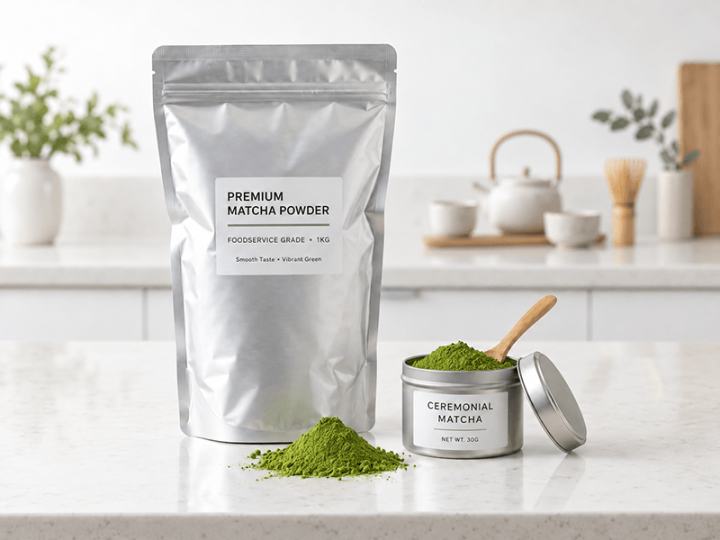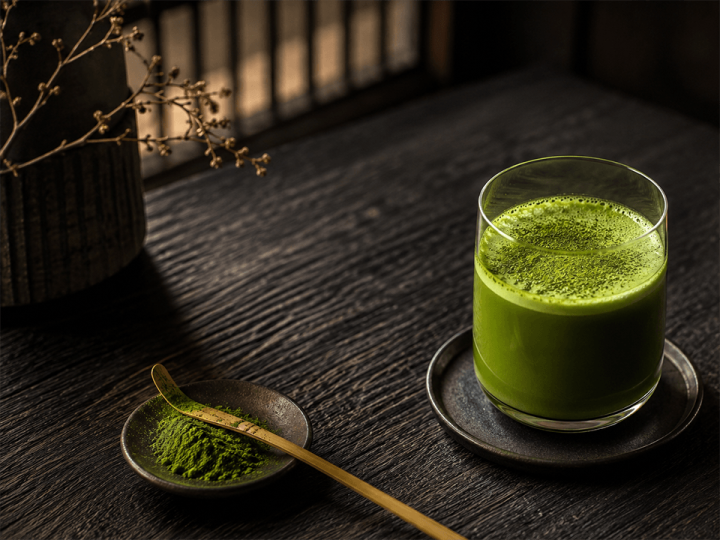
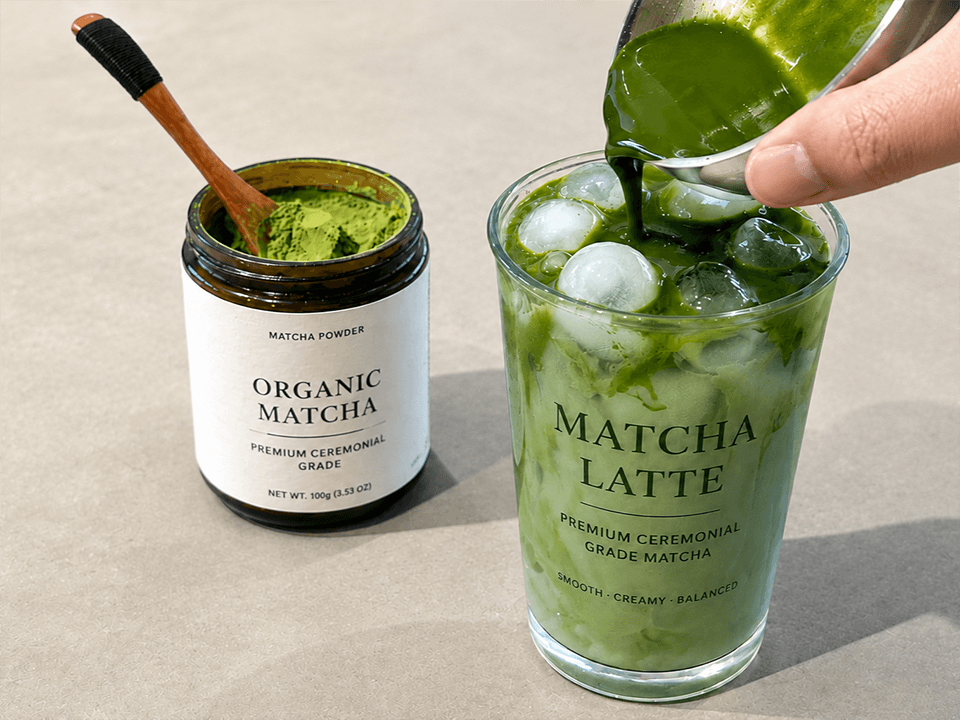
How much matcha should a café use in one drink?
It sounds like a simple recipe question, but for a commercial café, the answer affects much more than flavor.
Matcha dosage influences color, tea intensity, bitterness, milk balance, preparation consistency, ingredient cost and ultimately the margin on every drink sold.
Use too little and a matcha latte may look pale and taste mostly like milk. Use too much and the drink may become unnecessarily bitter, difficult to balance and expensive to produce.
The correct matcha dosage also changes with the drink.
A small hot latte does not necessarily need the same amount of powder as a 16 oz iced latte. Oat milk can cover tea flavor differently from dairy milk. Syrup, fruit puree, cold foam and ice dilution can all change the amount of matcha required to maintain a recognizable tea profile.
For most cafés, 2 to 3 grams per serving is a practical commercial testing range, but that should be treated as a starting point rather than a universal rule.
A better approach is to test the actual café formula at several controlled dosages.
For TangMist commercial sample evaluation, a useful benchmark is:
1.5 g → 2.0 g → 2.5 g → 3.0 g
Keep the milk, water, cup size and preparation method identical. Then compare finished color, tea strength, bitterness, mouthfeel and cost per cup.
The goal is not to use the most matcha possible.
It is to identify the lowest repeatable dosage that still delivers the customer experience the café wants to sell.
Why Matcha Dosage Matters More Than Most Cafés Expect
Matcha is often purchased by price per kilogram, but cafés sell it by the cup.
That difference changes the economics of product selection.
A cheaper powder that requires 3.5 grams to produce enough flavor may cost more per drink than a stronger matcha that works effectively at 2 grams.
At the same time, simply choosing the most concentrated or most expensive matcha does not automatically improve the drink. A strong powder used at an excessive dosage can create bitterness and astringency that require more syrup or milk to correct.
The commercial question should therefore be:
What matcha dosage gives us the required color and tea intensity without adding unnecessary ingredient cost?
That question should be answered in the actual recipe, not by tasting the powder alone.
Start with Grams, Not Scoops
One of the easiest ways for cafés to improve matcha consistency is to define the recipe by weight.
A teaspoon is not a reliable commercial measurement.
Powder can settle inside a container, different matcha products can have different bulk density and one barista’s “level spoon” may be another barista’s “slightly heaped spoon.”
Those differences become significant across hundreds or thousands of drinks.
During recipe development, use a scale capable of measuring small quantities accurately and define the matcha dosage in grams.
Once the recipe has been approved, the café can decide whether a dedicated portion scoop produces acceptable operational consistency.
The official recipe should still retain the gram weight as the reference.
A Practical Café Starting Range
For many milk-based café drinks, the most useful development range is between 1.5 and 3 grams of matcha per serving.
Below this range, larger milk drinks can begin to lose recognizable matcha character. Above this range, ingredient cost and bitterness can rise quickly depending on the matcha.
Cup size changes the picture.
Two grams may create a clear matcha character in an 8 oz drink but appear weak in a large iced latte containing significantly more milk and melting ice.
The grade of matcha matters as well, but this article deliberately focuses on dosage rather than creating another grade hierarchy.
The same matcha should first be tested at several weights before the café decides that it needs a more expensive or stronger grade.
The 1.5 g to 3 g Matcha Dosage Test
A useful commercial test uses the exact same milk formula while changing only the amount of matcha.
For a benchmark comparison, a café could use approximately 40 ml of water and 180 ml of unsweetened dairy milk for each drink. No syrup should be added during the first test because sweetness can hide differences in tea intensity.
The four samples should be prepared using the same water temperature, mixing method, milk brand and final volume.
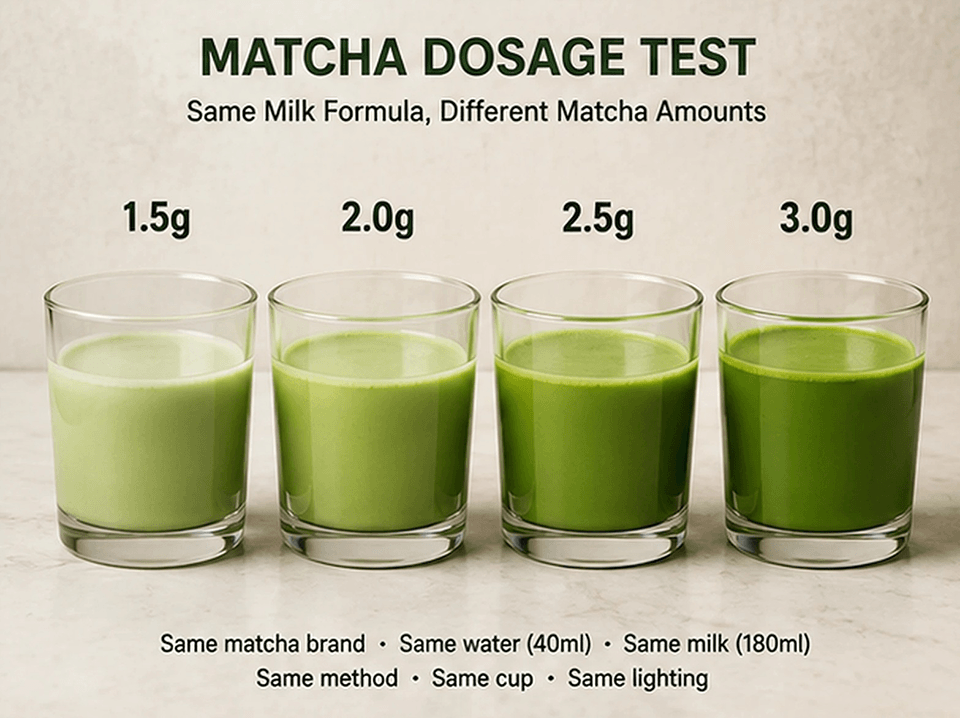
The following table describes the typical direction of change a café should evaluate. These descriptions are a development framework rather than claimed TangMist laboratory results; real observations should be recorded using the actual matcha being considered.
Matcha Dosage Comparison
| Matcha Dose | Expected Visual Position | Tea Intensity | Likely Commercial Use | Main Risk to Check |
|---|---|---|---|---|
| 1.5 g | Lightest green of the four | Mild | Smaller drinks, subtle matcha beverages or higher-intensity grades | May disappear in milk or after ice dilution |
| 2.0 g | Light to medium green | Balanced | Strong starting point for smaller hot lattes | May remain too light for larger or flavored drinks |
| 2.5 g | Medium to richer green | Clearly recognizable | Strong general café benchmark for milk-based drinks | Check bitterness and cost versus 2 g |
| 3.0 g | Deepest natural green | Strong | Larger iced drinks, rich oat milk or flavored beverages | May become unnecessarily bitter or expensive |
The expected progression is not simply “more grams equals better.”
The 3 gram sample may have the strongest color but lose on balance and margin. The 2 gram sample may provide the best value when the matcha already has good milk performance.
This is why the café should score the finished drink rather than selecting the darkest cup.
What to Look for During the Dosage Test
Begin with color.
Place all four drinks beside one another under the same lighting. The increase from 1.5 grams to 2 grams may be visibly meaningful, while the difference between 2.5 and 3 grams may be relatively small depending on the milk.
Next evaluate tea intensity.
The matcha should remain recognizable after milk is added without requiring the customer to search for the flavor.
Then evaluate bitterness and astringency separately.
A stronger tea taste is not automatically a defect, particularly in sweetened drinks. Excessive dryness or a harsh lingering finish, however, can indicate that the dose is above the useful range for that particular matcha.
Finally, consider cost.
If customers cannot meaningfully distinguish the 2.5 gram drink from the 3 gram drink, the extra half gram may not generate any commercial return.
Why 2 Grams Is Often a Useful Starting Point
Two grams works well as a development starting point because it sits high enough to reveal the matcha’s performance without immediately driving the recipe toward a high-cost dosage.
It is especially useful for smaller hot drinks where there is limited milk dilution.
However, “2 grams per cup” should not become a universal café rule.
The correct amount depends on cup size and recipe.
A 200 ml hot latte, a 350 ml iced latte and a 450 ml fruit matcha beverage cannot be expected to deliver the same tea intensity from exactly the same dose.
The recipe should scale according to sensory performance, not merely according to volume.
When 1.5 Grams Can Be Enough
A 1.5 gram serving can work when the cup is relatively small, the matcha has a strong flavor profile and the drink contains limited milk or sweetener.
It can also suit cafés deliberately offering a lighter matcha drink.
From a margin perspective, the dosage is attractive.
But the café should resist lowering the amount purely to reduce cost.
If customers perceive the drink as weak or mostly milk, saving a few cents of matcha can damage repeat purchase more than it improves gross margin.
The 1.5 gram version should therefore earn its place through sensory testing, not only through spreadsheet economics.
Why 2.5 Grams Is a Strong Commercial Benchmark
For many milk-based drinks, 2.5 grams is a particularly useful comparison point.
It often produces a more recognizable green color and stronger tea presence without automatically entering the intensity of a 3 gram serving.
This makes it useful for standard café lattes, especially when the menu must perform across both dairy and plant-based milk.
However, the extra 0.5 gram compared with a 2 gram recipe represents a 25% increase in matcha consumption.
That difference becomes important at scale.
If a café sells 300 matcha drinks per day, increasing the standard recipe from 2 grams to 2.5 grams uses an additional 150 grams every day.
The sensory improvement therefore needs to justify the additional raw-material requirement.
When 3 Grams Makes Sense
Three grams becomes more useful when the recipe contains stronger competing ingredients.
Large iced drinks are one example.
Ice initially occupies volume but also melts into the drink, increasing dilution over time. A recipe that tastes balanced immediately may become noticeably weaker after ten or twenty minutes.
Rich oat milk can create another challenge because sweetness, body and cereal-like flavor can cover delicate matcha character.
Flavored matcha drinks may require greater intensity as well. Strawberry puree, vanilla syrup, mango, coconut cream and flavored cold foam all compete with the tea.
In these applications, 3 grams may provide a commercially stronger result.
That does not mean every iced or oat milk drink needs 3 grams.
The result should still be compared against 2 and 2.5 grams.
Matcha Cost per Cup
Matcha cost should be calculated from the approved dosage, not only the wholesale price.
The formula is simple:
Matcha Cost per Cup = Matcha Price per kg ÷ 1,000 × Matcha Grams per Cup
This immediately shows why dosage matters.
The table below uses three illustrative wholesale prices rather than TangMist quotations. Actual pricing should always be calculated using the current grade and order volume.
Matcha Cost per Cup by Dosage
| Wholesale Matcha Price | 1.5 g | 2.0 g | 2.5 g | 3.0 g |
|---|---|---|---|---|
| USD 40/kg | $0.06 | $0.08 | $0.10 | $0.12 |
| USD 60/kg | $0.09 | $0.12 | $0.15 | $0.18 |
| USD 80/kg | $0.12 | $0.16 | $0.20 | $0.24 |
The difference can appear small when looking at one cup.
At scale, it becomes significant.
A café using a USD 60/kg matcha increases raw matcha cost from $0.12 to $0.18 when the serving rises from 2 grams to 3 grams.
That is only six cents per cup.
At 200 drinks per day, however, the difference becomes $12 per day, before considering waste.
Across 365 days, that represents more than $4,000 in additional matcha consumption for a single location.
The correct response is not always to reduce the dosage.
The correct response is to determine whether customers can perceive enough improvement to justify the additional ingredient cost.
Calculate Cost Before Finalizing Menu Price
Matcha should be treated like any other core café ingredient.
Before setting the retail price, calculate the complete recipe cost including matcha, milk, syrup, cup, lid, straw where applicable and any topping.
Then account for waste.
If the official recipe requires 2.5 grams but baristas regularly use an approximate scoop containing closer to 3 grams, the real cost will be higher than the costing sheet suggests.
Recipe standardization is therefore a margin-control tool, not just a quality-control tool.
Do Not Choose Matcha Only by Price per Kilogram
Consider two hypothetical products.
Matcha A costs $50/kg and requires 3 grams to create the desired latte.
Matcha B costs $65/kg but delivers the same customer-perceived intensity at 2 grams.
Matcha A costs $0.15 per serving.
Matcha B costs $0.13 per serving.
The more expensive ingredient is actually cheaper in the finished drink.
This is why commercial sample testing should combine sensory performance with cost in use.
A low wholesale price has limited value when the recipe needs significantly more powder.
Hot Matcha Latte Dosage
Hot lattes usually experience less dilution than iced drinks, making them a useful starting format for recipe development.
A café can begin testing around 2 grams and adjust upward or downward according to cup size and matcha strength.
For a smaller 8 oz hot drink, 1.5 to 2 grams may produce enough character.
A larger 10–12 oz drink may perform better around 2 to 2.5 grams.
The exact ratio depends on how much milk is used and how strongly the café wants matcha to lead the drink.
The water portion should be enough to disperse the powder thoroughly without unnecessarily diluting the milk base.
Once the hot recipe has been approved, document it and resist adjusting the dosage by eye during busy service.
Iced Matcha Latte Dosage
Iced drinks require separate testing.
The common mistake is to take the hot recipe, pour it over ice and assume the same amount of matcha will produce the same result.
Ice changes both volume and time.
The drink may taste strong immediately but gradually dilute as the ice melts.
Larger cold cups also usually contain more total liquid than hot cups.
For this reason, a 2.5–3 gram test range is especially useful for iced matcha lattes.
Evaluate the drink immediately after preparation and again after approximately 10–20 minutes.
The goal is not to prevent all dilution. It is to make sure the drink remains recognizably matcha during a realistic takeaway consumption period.
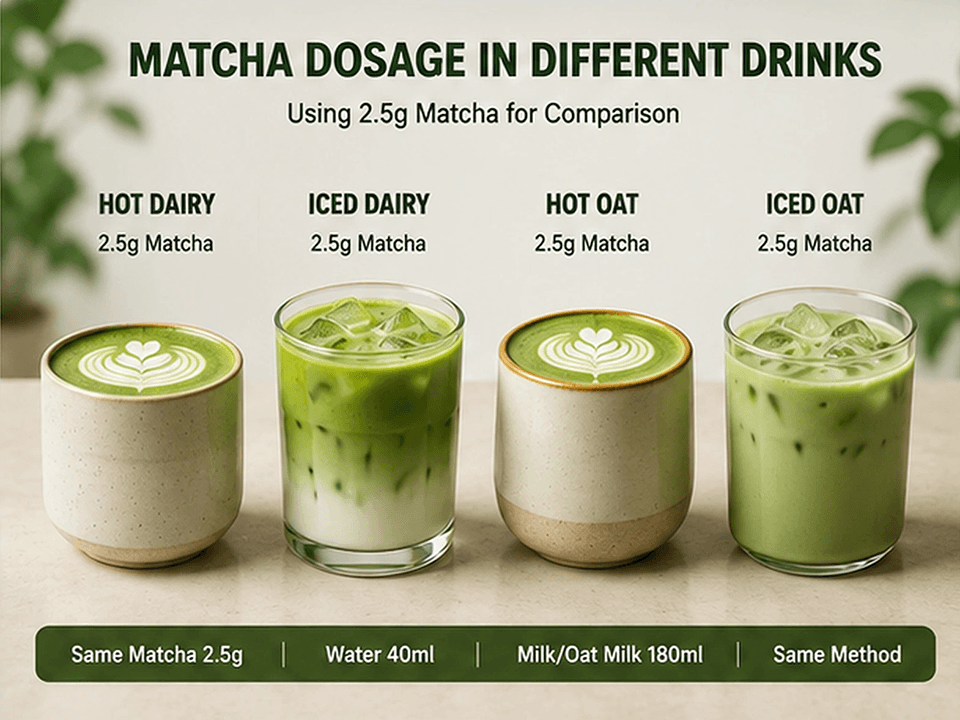
Oat Milk Matcha Dosage
Oat milk has become one of the most important matcha pairings in modern cafés.
It also presents a formulation challenge.
Many barista oat milks have more sweetness, body and cereal character than dairy milk. Those characteristics can make a delicate matcha taste softer than expected.
A café using oat milk as its primary plant-based option should test the actual brand planned for service.
Do not approve the matcha using dairy milk and assume the same recipe will transfer perfectly.
A useful development range is 2 to 3 grams, with 2.5 grams often serving as the key comparison point.
Some matcha will remain clear and recognizable at 2 grams. Other products may need 2.5 or 3 grams to compete with a rich oat milk base.
The decision should be based on flavor and margin rather than automatically increasing the dose.
Sweetened and Flavored Matcha Needs Separate Testing
Syrup changes the way customers perceive tea.
Sweetness can soften bitterness, which sometimes allows a stronger matcha dosage to remain pleasant.
At the same time, flavors such as strawberry, mango, vanilla and coconut can cover delicate tea aroma.
A café selling a plain matcha latte and a strawberry matcha should therefore not assume that both drinks need exactly the same dosage.
The flavored version may need more matcha to maintain recognizable tea character.
The most efficient approach is to develop the plain latte first.
Then use the approved base to test flavored extensions.
This keeps the menu system consistent while allowing adjustments where the additional ingredients genuinely require them.
Standardized Café Recipe Cards
Once the preferred dose has been selected, the recipe should be documented in a format that baristas can repeat.
The card should define grams rather than vague wording such as “one scoop” unless the scoop has been verified against the target weight.
It should also define water volume, milk volume, ice and mixing sequence.
TangMist Commercial Matcha Recipe Card Framework
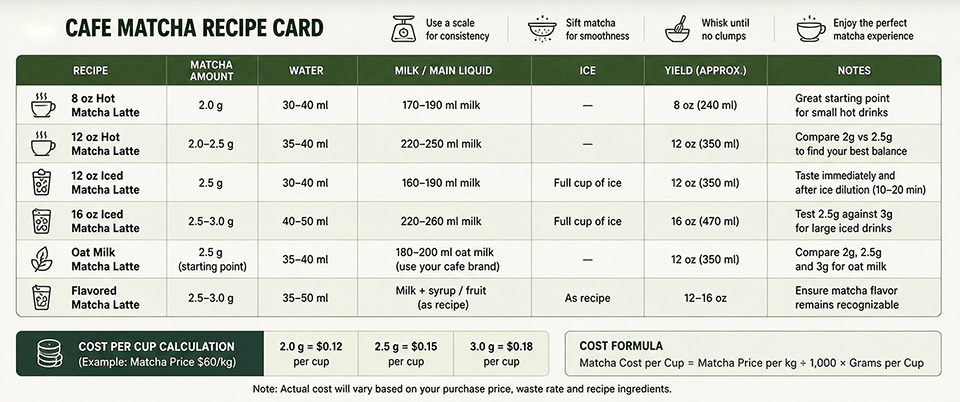
These recipes are development starting points, not universal formulas.
Cup design, ice volume, matcha strength and milk composition can all justify changes.
Once a café approves its formula, it should create its own final recipe card rather than continuing to operate from a broad range.
Keep the Water-Matcha Ratio Consistent
Dosage is easier to compare when the initial matcha concentrate is prepared consistently.
If one barista mixes 2 grams with 30 ml of water and another uses 80 ml, the final latte may have different body and perceived intensity even when the total matcha weight is identical.
A standardized concentrate also improves workflow.
The café should define the matcha weight, water volume, water temperature and mixing time together.
Changing only one of those variables makes troubleshooting much easier.
Does More Water Make Matcha Weaker?
In the finished drink, total dilution matters.
However, the water used to disperse matcha is only one part of the recipe.
If the final beverage volume remains constant, adding more preparation water often means using slightly less milk.
That can alter both tea perception and texture.
This is another reason to define the entire recipe rather than stating only “2 grams of matcha.”
A usable café standard is:
matcha grams + preparation water + milk + sweetener + ice + final cup size
Those variables together create the customer experience.
How Cup Size Changes Matcha Dosage
Cup size should not be ignored.
The same 2 gram dose spread across 200 ml and 450 ml of finished drink produces very different tea intensity.
However, matcha does not always need to increase perfectly in proportion to cup volume.
A 16 oz drink does not necessarily need double the matcha used in an 8 oz drink because other variables also change.
The larger drink may contain more ice rather than double the milk. Sweetness may change perception. The selected matcha may also become overly bitter when scaled linearly.
Treat each major cup size as a separate recipe.
This is particularly important for chains offering small, medium and large sizes.
Should a Café Offer Different Matcha Strengths?
Some cafés allow customers to add an extra matcha shot or additional powder.
This can work commercially when the base recipe is already balanced.
The standard drink should not intentionally be weak in order to create an upsell.
Instead, the base recipe should represent the café’s intended flavor, while an extra matcha option serves customers who prefer stronger tea character.
The added amount should also be standardized.
For example, an extra 0.5 gram or 1 gram increment is much easier to cost and control than an undefined “extra scoop.”
Matcha Waste Can Be More Expensive Than Dosage
Recipe cost calculations often assume that every gram purchased reaches a customer.
Real cafés experience waste.
Powder may remain on the scale, inside a scoop or around the mixing bowl. Staff may overportion. Drinks may need to be remade after clumping or preparation errors.
A 5% loss can meaningfully increase effective ingredient cost across a high-volume operation.
Standardized containers, measured scoops, clear recipe cards and staff training can therefore create savings without reducing the amount of matcha intended for the customer.
Pre-Portioning Can Improve High-Volume Service
Busy cafés may consider pre-portioning matcha into defined daily or shift quantities.
This reduces repeated weighing during peak service while maintaining dosage control.
The method must still protect the powder from air, humidity and contamination.
Do not prepare large numbers of open powder portions and leave them exposed for long periods simply for speed.
An alternative is a verified dosing scoop combined with regular scale checks.
The scale remains the reference standard even if every drink is not weighed individually.
Build a Matcha Recipe Around the Customer, Not the Powder
A specialty tea customer may prefer a stronger vegetal character and lower sweetness.
A mainstream café customer may expect a creamier, softer latte.
A dessert-focused beverage shop may use matcha alongside fruit, cream and syrups.
These customers should not automatically receive the same formula.
The matcha dosage should support the product concept.
The important commercial standard is not whether a drink uses exactly 2 grams or 3 grams.
It is whether the recipe produces a repeatable experience that customers understand and are willing to purchase again.
Test Matcha Dose Before Changing Grade
When a latte is not performing well, cafés sometimes immediately request a stronger or more expensive matcha.
That may be unnecessary.
First test the existing product at several controlled dosages.
If 2 grams tastes weak but 2.5 grams creates the required result at an acceptable cost, changing supplier or grade may create more complexity than value.
If even 3 grams fails to produce enough tea character, then testing a different matcha becomes more reasonable.
This sequence makes supplier comparison more efficient.
Optimize the recipe first. Compare grades second.
How to Turn the 1.5–3 g Test into Original TangMist Content
This article has the strongest SEO potential when the dosage comparison is documented visually.
TangMist can prepare four drinks using the same milk formula and photograph them under identical lighting:
1.5 g, 2.0 g, 2.5 g and 3.0 g.
Use the same glass, milk volume, water volume and background.
Record observed color, tea intensity, bitterness and aftertaste without changing the formula.
Then repeat the leading two dosages in dairy milk and oat milk.
A third round can compare the same dosage in hot and iced versions.
This creates original information that competing articles cannot reproduce simply by rewriting generic matcha ratios.
The strongest final asset would combine:
four dosage photos + sensory scorecard + cost per cup + hot/iced/oat recipe card.
That turns a basic “how many grams?” article into a commercial reference page.
Frequently Asked Questions
How Much Matcha Should a Café Use per Cup?
A practical development range for many café drinks is approximately 1.5 to 3 grams per serving.
Two grams is a useful starting point for smaller hot drinks, while 2.5 to 3 grams may be more appropriate for larger iced, oat milk or flavored drinks.
The final amount should be confirmed in the actual recipe.
Is 1 Gram of Matcha Enough for a Latte?
It can work in a small or deliberately mild drink, but 1 gram may become difficult to taste after a larger amount of milk is added.
Commercial cafés should compare it with higher dosages before choosing it primarily for cost savings.
Is 2 Grams of Matcha Enough for a Latte?
For many smaller hot matcha lattes, 2 grams is a useful starting point.
Larger drinks, oat milk or strongly flavored formulas may require more.
Is 3 Grams of Matcha Too Much?
Not necessarily.
Three grams can work well in larger iced drinks or formulas where milk, ice and flavors compete strongly with matcha.
The café should check bitterness, astringency and cost before adopting it as the standard.
How Much Matcha Should Be Used in an 8 oz Latte?
Around 1.5 to 2 grams is a practical testing range, with 2 grams being a strong benchmark.
The exact amount depends on the matcha and milk.
How Much Matcha Should Be Used in a 12 oz Latte?
Approximately 2 to 2.5 grams provides a useful development range for many hot lattes.
Iced versions may need more because of dilution.
How Much Matcha Should Be Used in a 16 oz Iced Latte?
Approximately 2.5 to 3 grams is a useful starting test range.
The recipe should be tasted after some ice has melted, not only immediately after preparation.
How Much Matcha Should Be Used with Oat Milk?
Start around 2 to 2.5 grams and compare up to 3 grams.
Rich or sweet oat milk can cover delicate tea flavor, so the actual milk brand matters.
Does More Matcha Make a Better Latte?
No.
Increasing dosage strengthens color and tea flavor, but it can also increase bitterness, astringency and cost.
The objective is the lowest dose that delivers the approved customer experience.
How Much Does Matcha Cost Per Cup?
Divide the price per kilogram by 1,000 and multiply it by the grams used.
At $60/kg, a 2 gram serving costs $0.12 in matcha, while a 3 gram serving costs $0.18 before freight, waste and other recipe ingredients.
Should Cafés Measure Matcha by Teaspoon or Grams?
Use grams during development and as the official reference.
A dedicated scoop can be introduced for service only after the café confirms that it repeatedly delivers the intended weight.
Should Hot and Iced Matcha Use the Same Dosage?
Not automatically.
Iced drinks often have larger cup sizes and experience dilution as ice melts, so they may need a higher dose.
Should Dairy and Oat Milk Use the Same Matcha Recipe?
They can, but they should be tested separately.
Oat milk often has more sweetness and cereal character, which can change perceived matcha strength.
Does a Higher-Grade Matcha Require Less Powder?
Sometimes, but grade labels alone do not predict dosage efficiency.
The only reliable method is to compare samples in the same finished recipe.
What Is the Best Matcha Ratio for a Café?
There is no universal ratio.
The best commercial ratio balances matcha intensity, milk volume, customer preference, preparation consistency and cost per cup.
Final Thoughts
The question “How much matcha should a café use per cup?” does not have one number that works for every drink.
For many cafés, 1.5 to 3 grams provides the most useful development range.
A smaller hot latte may perform well around 2 grams.
A standard milk-based drink may benefit from 2.5 grams.
A larger iced, oat milk or flavored beverage may require closer to 3 grams.
But the highest dosage is not automatically the best one.
The right dosage is the lowest amount that consistently delivers the required matcha flavor, natural green appearance and customer experience.
Test 1.5, 2, 2.5 and 3 grams under identical conditions.
Evaluate the finished drink rather than the powder alone.
Calculate cost per cup before approving the recipe.
Then document the result in a standardized recipe card that every barista can reproduce.
For café operators, that process improves not only flavor consistency but also inventory planning, staff training and gross-margin control.
Build a Café Matcha Recipe with TangMist
TangMist supplies matcha powder for cafés, beverage shops, distributors and commercial drink projects.
Café buyers can compare matcha samples using their actual cup size, dairy or plant-based milk, sweetness level and target dosage instead of selecting a product by grade name alone.
For a commercial evaluation, prepare the same formula at several dosages and compare color, matcha intensity, bitterness and cost in use.
Request Matcha Samples for Café Testing
Provide the drink size, milk type, current matcha dosage, expected daily volume and preferred flavor profile when requesting samples.
Contact TangMist to compare matcha options using the recipe your customers will actually drink.