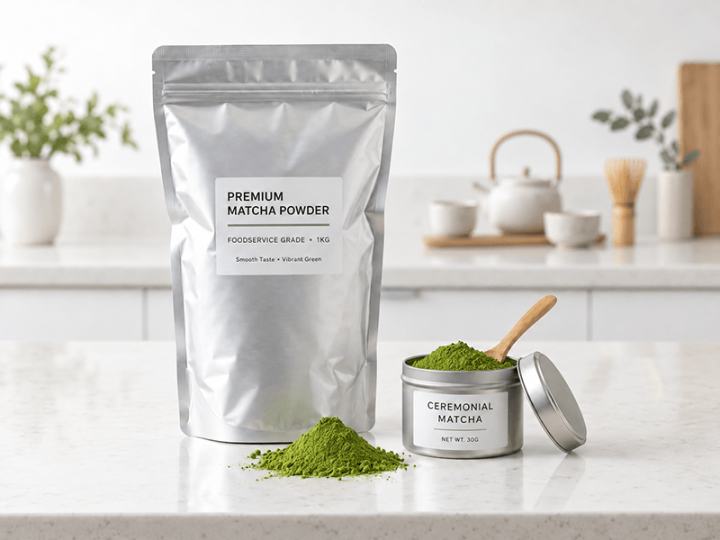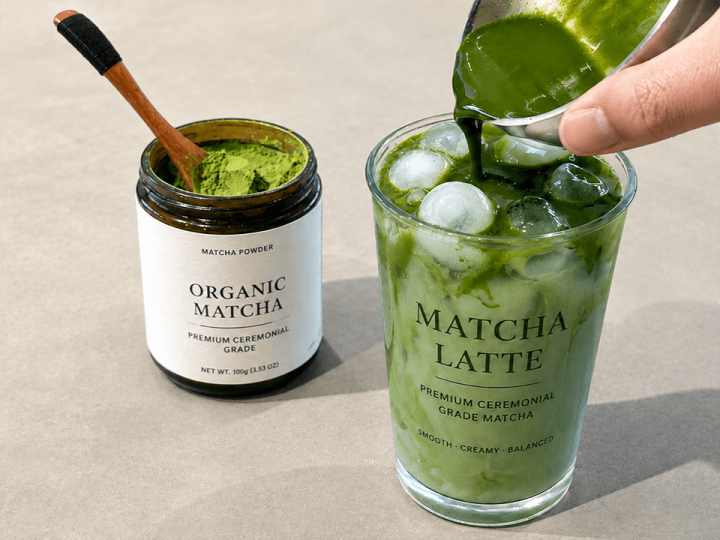
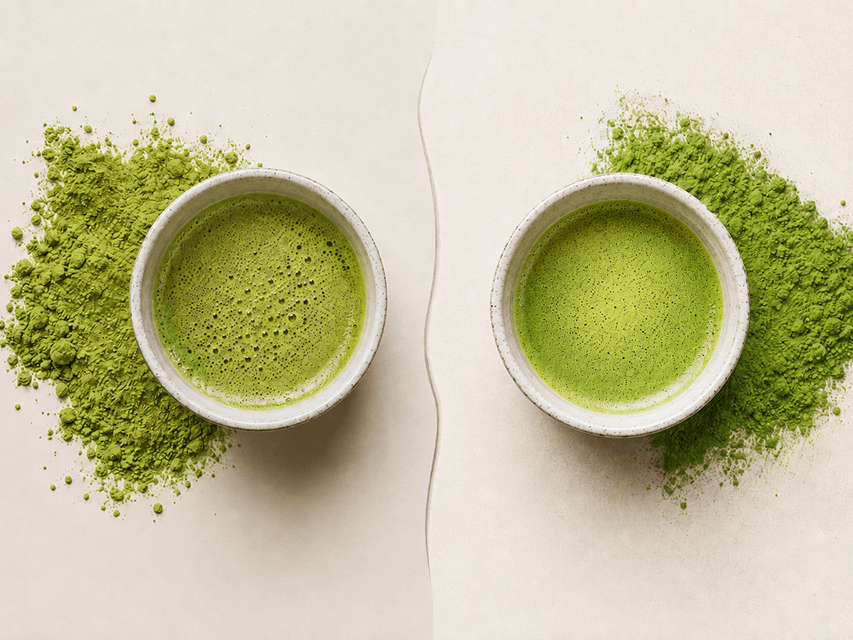
The difference between ceremonial and culinary matcha is often presented as a simple quality hierarchy.
Ceremonial matcha is described as smooth, vibrant and premium, while culinary matcha is described as stronger, more bitter and intended for cooking. Buyers are then encouraged to use the first for drinking and the second for food.
That explanation is convenient, but it is not sufficient for commercial purchasing.
A café may achieve better latte performance with a balanced culinary or café-oriented matcha than with an expensive ceremonial product. A premium dessert brand may need a refined matcha that sits above an ordinary food grade. A private label business may prefer one versatile powder that works in both water and milk rather than maintaining products at opposite ends of a supplier’s range.
The terms ceremonial and culinary also do not create a universally harmonized international grading ladder. Different suppliers may apply them according to their own product range, target market and pricing structure.
For buyers, the most useful question is not whether ceremonial matcha is automatically better than culinary matcha.
The better question is:
Which matcha delivers the required flavor, color and customer experience in the finished product at a commercially practical dosage?
This guide explains how commercial buyers should compare ceremonial vs culinary matcha, where each category usually creates value and how to approve the right product for cafés, beverage brands, food manufacturers, distributors and private label projects.
Begin by Confirming That the Product Is Matcha
Before comparing grades, buyers should confirm exactly what each supplier is offering.
The supplier should identify the raw tea material, processing method, product code, country or region of origin and complete ingredient declaration. It should also be clear whether the sample is pure matcha or a formulated powder containing sugar, flavoring, creamer or other ingredients.
This distinction matters because green tea powder, instant green tea extract and a sweetened matcha blend should not be compared directly with pure matcha.
Grade comparisons only become meaningful after the identity of every sample has been confirmed.
Are Ceremonial and Culinary Official Matcha Grades?
Ceremonial and culinary are useful commercial descriptions, but buyers should not treat them as complete technical standards.
One supplier’s ceremonial matcha may differ from another supplier’s ceremonial product in harvest timing, cultivar, shading, aroma, bitterness, color and price.
Culinary matcha can vary just as widely. One option may be designed for affordable bakery products, while another may be a relatively smooth and bright grade developed for premium lattes, ice cream or chocolate.
Internal names such as 3A, 5A, 6A and 7A are also normally meaningful only within the supplier’s own range.
Every grade name should therefore be connected to a physical sample, supplier product code, intended application, written specification, quotation and retained approval sample. Without those references, a name such as ceremonial or premium offers limited protection against future product changes.
Ceremonial vs Culinary Matcha at a Glance
The following comparison reflects common commercial positioning rather than a universal grading rule.
| Buying Factor | Ceremonial Matcha | Culinary Matcha | What Buyers Should Verify |
|---|---|---|---|
| Primary positioning | Pure drinking and premium retail | Lattes, food and formulated products | Supplier’s recommended application |
| Typical flavor | Smoother, softer and more refined | Stronger, more bitter or more assertive | Flavor in the finished product |
| Aroma | Often more delicate and noticeable in water | Usually selected for stronger application performance | Whether other ingredients cover the aroma |
| Color | Frequently positioned around a vivid natural green | Can range from bright commercial green to deeper tones | Finished-product color |
| Bitterness | Usually expected to be controlled | May provide greater strength in milk or food | Balance at the target dosage |
| Common packaging | Smaller tins and premium retail pouches | Bulk bags and foodservice formats | Available packaging and MOQ |
| Price position | Generally higher | Generally more economical | Effective cost per serving |
| Best evaluation | Water and lightly formulated drinks | Complete beverage or food formula | Standardized application testing |
A smooth culinary matcha may outperform a lower-positioned ceremonial sample. A robust ceremonial grade may also work well in a premium latte.
The category name should help buyers choose which samples to test, not determine the final purchase automatically.
What Ceremonial Matcha Usually Means
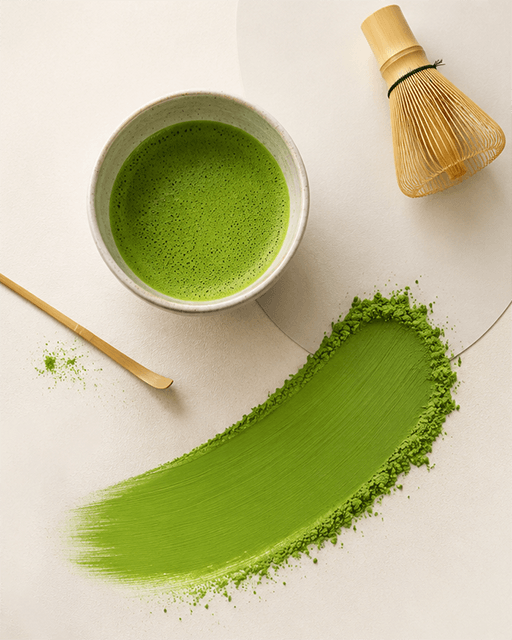
Ceremonial matcha is generally positioned for preparation with water or for premium products in which matcha remains the main sensory feature.
Because few other ingredients are present to hide roughness, the buyer normally expects a fresh aroma, smooth mouthfeel, controlled bitterness and pleasant finish.
Traditional tencha cultivation uses shading before harvest. Japan’s Ministry of Agriculture, Forestry and Fisheries explains that covered cultivation limits sunlight and helps produce tea with richer umami and less bitterness. It also describes tencha production as steaming and drying shaded leaves without rolling before removing stems and veins and grinding the leaf material into powder.
However, a ceremonial label alone does not prove a specific shading period, harvest date, cultivar or production region.
When those details support the product’s positioning or price, they should be confirmed for the actual matcha being purchased.
The Expected Ceremonial Sensory Profile
When prepared with water, a suitable ceremonial matcha is generally expected to offer a recognizable tea aroma, rounded texture, moderate sweetness or umami and a clean aftertaste.
The exact profile may still vary.
Some matcha has stronger marine or savory notes. Other products lean toward fresh grass, vegetables or mild nuttiness. A sample may be technically refined but still fail to match the taste preferences of the brand’s customers.
Private label buyers should therefore select ceremonial matcha according to their intended audience rather than assuming the smoothest or most expensive sample will always create the strongest product.
When Ceremonial Matcha Creates Commercial Value
Ceremonial matcha creates the most value when customers can experience its more delicate qualities.
This commonly includes pure matcha prepared with water, premium traditional-style retail products, tasting collections, gift products and lightly formulated café beverages with limited milk or sweetener.
It may also support products built around cultivar, estate, harvest or origin storytelling, provided those details can be documented for the supplied product.
In these applications, customers are more likely to notice the aroma, texture and finish that support a higher ingredient cost.
What Culinary Matcha Usually Means
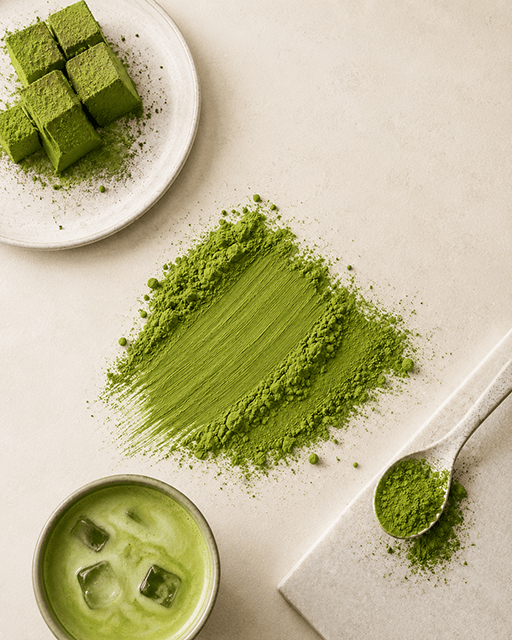
Culinary matcha is generally selected for products containing other ingredients or undergoing additional processing.
Milk, sugar, flavoring, flour, butter, cocoa butter, protein ingredients and fruit can all reduce the visibility of delicate matcha characteristics.Heat, freezing and prolonged storage may create additional performance requirements.
Culinary matcha is therefore often selected to provide stronger color or tea character at a commercially practical dosage.
This does not mean culinary matcha is automatically poor quality.
Its value should be judged by how it performs in the finished product rather than by how closely it resembles a matcha intended for drinking with water.
Culinary Matcha Is a Broad Category
A basic culinary powder may be suitable for heavily flavored cookies or economical premixes. A brighter food grade may be developed for ice cream or white chocolate. A premium culinary or café grade may provide the balance required for milk-based drinks.
These products should not be treated as interchangeable.
A supplier offering several culinary options should explain the intended role of each one. The buyer should then request only the samples relevant to the product under development.
When Culinary Matcha Creates Commercial Value
Culinary matcha is often more suitable for dairy and plant-based lattes, sweetened café drinks, flavored matcha beverages, instant powders, bakery products, ice cream, confectionery, protein blends and food manufacturing.
These applications contain ingredients or processing conditions that may cover subtle aroma and soften tea flavor.
A stronger application-focused powder can therefore provide clearer color and more recognizable matcha character than a delicate ceremonial option, sometimes at a lower cost per finished unit.
Ceremonial vs Culinary Matcha by Application
The best starting category depends on what the finished product requires from the matcha.
| Product Application | Recommended Starting Point | Why | Main Approval Test |
|---|---|---|---|
| Pure matcha with water | Ceremonial or refined drinking grade | Aroma, texture and finish remain exposed | Prepare at the intended water temperature and dosage |
| Premium retail matcha | Ceremonial or versatile premium grade | Supports direct drinking and premium positioning | Test using the final package instructions |
| Everyday home matcha | Premium culinary or accessible drinking grade | Customers may use both water and milk | Test both main preparation methods |
| Unsweetened café latte | Premium culinary, café grade or robust ceremonial | Requires smoothness and milk performance | Test with the exact milk and cup size |
| Sweetened or flavored latte | Culinary or application-focused café grade | Syrups and flavors can cover delicate matcha | Test the complete menu recipe |
| Instant matcha sachet | Culinary or blend-specific grade | Must perform at a fixed fill weight | Test the complete powder formula |
| Ready-to-drink beverage | Formulation-selected commercial grade | Processing and storage influence performance | Test after processing and during stability work |
| Bakery | Culinary or food-manufacturing grade | Flour, sugar, fat and heat reduce subtle notes | Test in the actual baked product |
| Ice cream | Bright culinary or premium food grade | Cold, sweetness and fat soften tea intensity | Evaluate after freezing |
| White chocolate | Bright, assertive culinary grade | Matcha must balance sweetness and cocoa butter | Test in the finished chocolate base |
This framework should guide sampling rather than replace it.
A lightly sweetened premium latte and a large iced strawberry matcha may both appear on a café menu, but they are unlikely to require the same matcha profile.
Is Ceremonial Matcha Better for Lattes?
Not automatically.
Milk reduces matcha’s visual intensity, softens bitterness and can cover delicate aroma. Rich oat milk, coconut milk, syrups and flavored creams may further reduce the differences that justify a premium drinking grade.
A ceremonial matcha can create an elegant, lightly sweetened latte when its flavor remains noticeable at a practical dosage.
However, the same matcha may appear weak in a large iced drink. Increasing the amount of powder can improve the result but may make the drink commercially expensive.
A balanced café or premium culinary grade may produce stronger tea character at a lower cost per cup.
Buyers should compare samples using the same matcha weight, water volume, milk, cup size, ice, sweetener and mixing method. The decision should be based on finished color, tea strength, bitterness, mouthfeel and cost per serving.
The ceremonial label alone cannot predict latte performance.
Can Culinary Matcha Be Drunk with Water?
Some culinary matcha can be prepared with water, but not every product will create a pleasant pure-drinking experience.
A premium culinary grade may have sufficient smoothness for everyday use. A lower-cost food-manufacturing powder may taste noticeably more bitter, dry or rough without milk and sugar.
Brands expecting customers to prepare the product in both water and milk may need a versatile middle grade rather than a product at either end of the range.
The packaging should also describe the product honestly. A matcha that has only been approved for sweetened lattes should not be positioned as a refined traditional drinking product without further testing.
Does Ceremonial Mean More Nutritious?
Buyers should not assume that a higher sensory or price position creates a simple nutritional hierarchy.
A 2025 study compared hot-water preparations made from ten commercially available ceremonial and culinary matcha products. In that sample group, culinary products had higher average total phenolic content and higher measured CUPRAC antioxidant capacity, while ceremonial products had higher average chlorophyll and caffeine levels.
The results do not establish a universal rule for every product. The study examined a limited selection of commercially labeled matcha, and composition can vary by raw material, harvest, processing and analytical method.
The practical lesson for buyers is that ceremonial and culinary labels should not be used as substitutes for product-specific laboratory data.
When chemical composition matters to a formula or claim, testing should be conducted on the actual supplied product or batch.
Understand the Role of Shading, Harvest and Raw Material
Raw material decisions influence the sensory and physical characteristics of matcha.
MAFF describes covered cultivation as a method used for tencha and other shaded teas. By reducing sunlight, this approach supports richer umami and lower bitterness. The same official description notes that tencha is steamed and dried without rolling before stems and veins are removed and the remaining leaf material is ground.
Commercial ceremonial products are often associated with younger or earlier-harvest leaves, while culinary products are frequently associated with later or more mature material.
However, these are broad tendencies rather than enough information to approve a sample.
Cultivar, field conditions, blending, processing, grinding and storage can all affect the final result. A first-harvest statement does not guarantee that the product will suit a customer’s recipe, and a later-harvest product is not automatically unsuitable for a premium formulated application.
Buyers should ask how the raw-material information affects the flavor and performance of the actual sample being offered.
Do Not Compare Matcha by Dry Color Alone
Color is commercially important, but it should not be the only selection criterion.
Dry powder can appear different according to lighting, camera exposure, sample thickness and moisture condition. A supplier photograph taken under bright studio lighting cannot replace a controlled side-by-side evaluation.
More importantly, the dry powder is not what the final customer sees.
Milk, water, sugar, fat, flour and other ingredients dilute the green color. Processing and storage can also affect appearance.
Samples should first be inspected under the same neutral lighting, using identical containers and quantities. They should then be prepared with the same water conditions and finally tested in the complete commercial product.
For café and food-manufacturing projects, the finished-product comparison should carry more weight than the dry-powder photograph.
Compare Bitterness in the Finished Product
Bitterness is frequently presented as a weakness of culinary matcha, but some bitterness can help the tea remain recognizable after milk, sugar or fat is added.
The problem is not bitterness itself. The problem is uncontrolled bitterness that creates a harsh, dry or unpleasant finish.
A culinary matcha may taste too strong in water but become properly balanced in a sweetened latte or ice cream. A ceremonial sample may be beautifully smooth in water but disappear in the same formula.
Buyers should judge bitterness where the customer will experience it.
The selected product should provide enough tea structure without forcing the brand to add excessive sweetener or increase the matcha dosage beyond the target cost.
Consider Whether Delicate Aroma Will Survive
Ceremonial matcha is often valued for its more refined aroma, but that aroma must remain noticeable in the finished product to create commercial value.
In pure tea, aroma is immediately exposed. In a latte, it competes with milk. In a flavored drink, it competes with syrup, fruit and toppings. In bakery products, it must survive mixing and heating.
Paying for delicate aroma is less useful when the formula prevents customers from experiencing it.
For strongly formulated foods and beverages, persistent tea character may be more valuable than subtle complexity.
Compare Cost Per Serving, Not Only Price Per Kilogram
Ceremonial matcha is generally more expensive, but price per kilogram does not reveal the complete commercial cost.
Dosage must also be considered.
The calculation is:
Matcha cost per serving = price per kilogram ÷ 1,000 × grams used
Suppose one matcha costs less per kilogram but requires twice as much powder to achieve the target flavor. Its cost per drink may be equal to or higher than the apparently more expensive option.
The same principle applies to sachets, bakery products, ice cream and confectionery.
The commercial comparison should use the lowest dosage that repeatedly achieves the approved product standard. Development teams should avoid approving a product at one dosage and increasing it after launch without recalculating margin, inventory demand and preparation instructions.
Avoid Over-Specifying the Matcha
Over-specification occurs when the brand pays for qualities that customers cannot experience in the finished product.
Using a delicate ceremonial matcha in a heavily sweetened strawberry beverage may increase the ingredient cost without creating a clear sensory benefit.
The same issue can arise in cookies, protein powders, cake mixes and strongly flavored confectionery.
Over-specification can reduce gross margin, increase working-capital requirements and make the product more sensitive to shortages of premium raw material.
This does not mean ceremonial matcha should never be used in formulated products. The finished product should simply preserve enough of its value to justify the additional cost.
Avoid Under-Specifying the Matcha
Under-specification creates the opposite problem.
A rough, dull or excessively bitter culinary matcha may require more sweetener, a higher dosage or substantial reformulation. It may weaken the finished color, reduce preparation consistency and make premium pricing difficult to support.
The lowest-priced matcha is therefore not always the lowest-cost commercial option.
Buyers should establish the minimum acceptable sensory and application standard before comparing supplier prices.
How Buyers Should Evaluate Samples
Ceremonial and culinary samples should be compared under the same controlled process.
| Evaluation Area | Ceremonial Matcha Test | Culinary Matcha Test | Approval Question |
|---|---|---|---|
| Product identity | Confirm pure matcha and supplier code | Confirm pure matcha or complete blend | Is the product clearly defined? |
| Dry appearance | Inspect color, aroma and powder condition | Inspect color, aroma and powder condition | Does it match the intended positioning? |
| Water preparation | Evaluate smoothness, umami, bitterness and finish | Establish baseline strength and roughness | Is any water-use claim realistic? |
| Final application | Test the intended preparation or light formula | Test the complete commercial formula | Does the customer experience match the concept? |
| Dosage range | Compare practical drinking dosages | Identify the lowest effective inclusion level | What is the real cost per unit? |
| Holding performance | Observe short-term color and texture | Observe settling, separation or process effects | Does it remain acceptable during use? |
| Repeatability | Prepare the product several times | Repeat under production or service conditions | Can different staff reproduce the result? |
| Documentation | Review specification and batch details | Review specification and application requirements | Can the supplier repeat the approved product? |
Price and marketing names can influence sensory judgment, so samples can initially be assigned neutral codes.
The buyer should record every preparation variable, including powder weight, water temperature, mixing method, milk, sweetener, processing time and holding period.
After approval, a sealed portion of the selected sample should be retained as a reference for the bulk order.
Convert the Grade Name into a Specification
The final purchase should not rely only on a product name such as “Ceremonial A” or “Premium Culinary.”
The approved matcha should be connected to a written specification that identifies the product code, ingredient identity, origin, sensory profile, color reference, moisture limit, particle-size reference and relevant microbiological requirements.
The specification may also define packaging, storage conditions, shelf life, batch coding, Certificate of Analysis requirements and change-notification rules.
Matcha is an agricultural product, so some natural variation should be expected. The agreed range should nevertheless remain compatible with the buyer’s recipe, product positioning and customer expectations.
Changes to the source, blend, processing facility or product code should be communicated before production when they may affect the approved product.
Do Not Use “Ceremonial” as a Substitute for Quality Control
A ceremonial label does not replace food-safety documentation, laboratory testing, traceability or supplier verification.
The buyer still needs to confirm the product specification, production facility, batch documentation and requirements of the destination market.
The same principle applies to culinary matcha.
A matcha intended for bakery or industrial production still needs to meet the applicable food-safety and regulatory requirements.
The testing plan should be based on the destination country, sales channel, customer specification, certification status and intended product—not on the grade name.
Should a Brand Use One Matcha or Several?
One versatile matcha can simplify purchasing, inventory, specifications and staff training.
This approach may work for a smaller brand offering pure matcha, simple lattes and lightly flavored drinks. A balanced premium or café-oriented grade can serve several related applications with minor dosage adjustments.
A one-grade system becomes less efficient as the products move further apart.
A matcha chosen for premium water preparation may be unnecessarily expensive for bakery, while a strong food grade selected for cookies may be too rough for drinking.
A two-grade system is often practical for brands with both consumer and foodservice applications. One refined product can support pure drinking and premium retail, while a stronger application grade can serve lattes, bakery and manufacturing.
A three-grade range may add a separate café matcha between the drinking and food-manufacturing products. This can improve application performance but also creates additional inventory, specifications, MOQs and purchasing management.
Another grade should only be added when it creates a clear performance or commercial advantage.
Name Matcha Products Responsibly
Product names should help customers understand intended use without presenting ceremonial as a scientific guarantee.
Descriptions such as “matcha selected for traditional-style preparation,” “smooth matcha for water and light lattes,” “strong matcha for café beverages” and “application-focused matcha for baking” may provide clearer guidance than an unexplained grade hierarchy.
When origin, cultivar, harvest, organic status or processing claims are included, they should be verified for the actual product and supply chain.
A supplier’s general catalogue should not be treated as evidence for every private label SKU or commercial batch.
Common Buyer Mistakes
Assuming Ceremonial Always Means the Best Matcha
Ceremonial generally indicates a premium drinking position, but it does not guarantee that the sample is the best choice for every product.
The final decision should be based on application performance and a written specification.
Assuming Culinary Means Low Quality
Culinary describes intended use more than absolute value.
A premium culinary matcha can produce better results than a delicate ceremonial product in lattes, ice cream, chocolate or drink mixes.
Comparing Only Two Extreme Samples
Comparing a supplier’s most expensive ceremonial matcha with its cheapest culinary powder creates an unrealistic choice.
Buyers should also test one or two middle-positioned options.
Approving Matcha Only in Water
A sample intended for milk, baking, chocolate or ice cream must be tested in that application.
A water tasting cannot predict complete formula performance.
Selecting the Greenest Dry Powder
Finished-product color, flavor, dosage and cost matter more than dry appearance alone.
Ignoring the Required Dosage
A low price per kilogram can become expensive when the product requires substantially more powder.
Using Undefined Grade Names in Purchase Orders
The purchase order should include the supplier code, approved specification, packaging and applicable batch requirements.
Expecting One Grade to Work Everywhere
Operational simplicity has value, but very different products may require different matcha profiles.
Frequently Asked Questions
What Is the Main Difference Between Ceremonial and Culinary Matcha?
Ceremonial matcha is generally positioned for preparation with water and premium applications where its sensory qualities remain visible.
Culinary matcha is generally selected for milk drinks, food products and formulated applications that require stronger performance.
The terms are commercial positioning categories rather than a complete universal grading system.
Is Ceremonial Matcha Higher Quality?
It is usually positioned at a higher sensory and price level for pure drinking.
That does not mean it will perform better in every latte, dessert or manufactured food product.
Can Ceremonial Matcha Be Used for Lattes?
Yes.
A robust ceremonial matcha may create a smooth premium latte, especially when milk and sweetener are limited. Its flavor strength and cost should still be tested in the intended recipe.
Is Culinary Matcha Good for Lattes?
A balanced culinary, café or latte-oriented matcha can work very well in milk-based drinks.
It should provide recognizable tea character without excessive bitterness or an impractical dosage.
Can Culinary Matcha Be Prepared with Water?
Some premium culinary grades are suitable for everyday water preparation. Lower-cost food grades may be too bitter or rough.
The sample must be tested rather than judged by its category name.
Is Ceremonial Matcha Suitable for Baking?
It can be used, but its delicate aroma and smooth finish may be reduced by flour, sugar, fat and heat.
A culinary matcha often provides better cost efficiency.
Why Is Ceremonial Matcha More Expensive?
The price may reflect more selective raw material, cultivation, harvest, processing, blending and sensory requirements.
Buyers should request product-specific information rather than assuming every ceremonial price is supported by the same factors.
Does Culinary Matcha Always Have a Duller Color?
No.
Culinary matcha varies significantly. Some products are developed specifically to provide strong green color in lattes, ice cream, white chocolate and bakery applications.
Are Ceremonial and Culinary Matcha Legally Defined?
They should not be treated as a universally harmonized international grading ladder.
Buyers should rely on physical samples, supplier product codes, specifications and application tests.
Should a Private Label Brand Offer Both?
A two-product range can work well when one matcha targets pure drinking and the other targets lattes or food applications.
A smaller brand may begin with one versatile product when its primary use is clearly defined.
How Should Buyers Approve a Matcha?
The matcha should be tested repeatedly in the final application, evaluated at several dosages, compared by cost in use and connected to a supplier code, specification and retained reference sample.
Final Thoughts
The ceremonial vs culinary matcha decision should not be reduced to premium versus cheap.
Ceremonial matcha is generally more appropriate when the tea is consumed directly and customers can experience its aroma, texture and finish.
Culinary matcha is generally more appropriate when the powder must compete with milk, sweetness, fat, flavoring or processing.
Neither category guarantees commercial success.
A weak ceremonial matcha may disappear in a latte. An under-specified culinary product may create excessive bitterness or poor color. A well-selected middle grade may outperform both in the intended application.
Buyers should begin with the finished product, request application-relevant samples and compare them using controlled recipes. The selected matcha should then be approved according to its effective dosage, cost, repeatability and written specification.
The right choice is not the product with the most impressive grade name.
It is the matcha that consistently delivers the experience the brand intends to sell.
Compare Ceremonial and Culinary Matcha with TangMist
TangMist supplies matcha powder for cafés, beverage brands, food manufacturers, distributors and private label projects.
Different matcha profiles can be evaluated for pure drinking, dairy and oat milk lattes, flavored beverages, instant powders, bakery, ice cream, chocolate and other commercial applications.
Rather than selecting matcha by grade name alone, buyers can compare finished-product color, smoothness, tea intensity, bitterness, required dosage and target cost.
TangMist can also support projects with bulk packaging, private label options, product specifications, batch documentation and application-based sample recommendations.
Request Matcha Samples for Your Application
For a more relevant recommendation, provide the intended product, serving size, main ingredients, target dosage, destination market, packaging format and estimated order quantity.
Contact TangMist to compare ceremonial, premium and culinary matcha options for your product and commercial requirements.