Evaluating matcha samples for commercial use requires more than placing several powders beside one another and choosing the brightest green option.
The best-looking dry sample may become weak after milk is added. A smooth matcha prepared with water may lose its character in a sweetened beverage. A lower-priced powder may need twice the dosage of another sample, making it more expensive in the finished product. A matcha that works in a freshly prepared drink may also settle, fade or become unbalanced after holding, heating or freezing.
Commercial matcha evaluation must therefore answer a practical question:
Which sample delivers the required color, flavor, texture and customer experience in the finished product at a commercially workable dosage?
The answer depends on the application. A café, beverage brand, bakery, ice cream manufacturer and private label tea company may evaluate the same samples differently because each product places different demands on the matcha.
A reliable process begins by defining the finished product, controlling the preparation variables and testing every sample under the same conditions. The preferred matcha must then be connected to a product code, commercial quotation, specification and retained reference sample.
This guide explains how to evaluate matcha samples systematically before approving a bulk or private label order.
Commercial Evaluation Is Different from Personal Tasting
Personal tasting asks which matcha an individual prefers.
Commercial evaluation asks whether the matcha can support a defined product, price point, preparation method and customer expectation.
A buyer may personally prefer the smoothest sample when it is prepared with water. However, the business may be developing a 450-milliliter iced oat milk latte with fruit syrup. In that application, a slightly stronger and more assertive matcha may create a better finished drink.
The most pleasant sample in isolation is not necessarily the most useful ingredient.
Commercial testing must consider repeatability as well. A product that tastes excellent only when prepared by an experienced tea specialist may be unsuitable for a café chain where many staff members must reproduce the recipe quickly.
The sample should therefore be evaluated both for its maximum potential and for its performance under normal operating conditions.
Confirm What Each Sample Actually Is
Before tasting, identify every sample clearly.
This distinction matters because pure matcha should not be compared directly with sweetened matcha powder, instant tea extract or a latte premix.
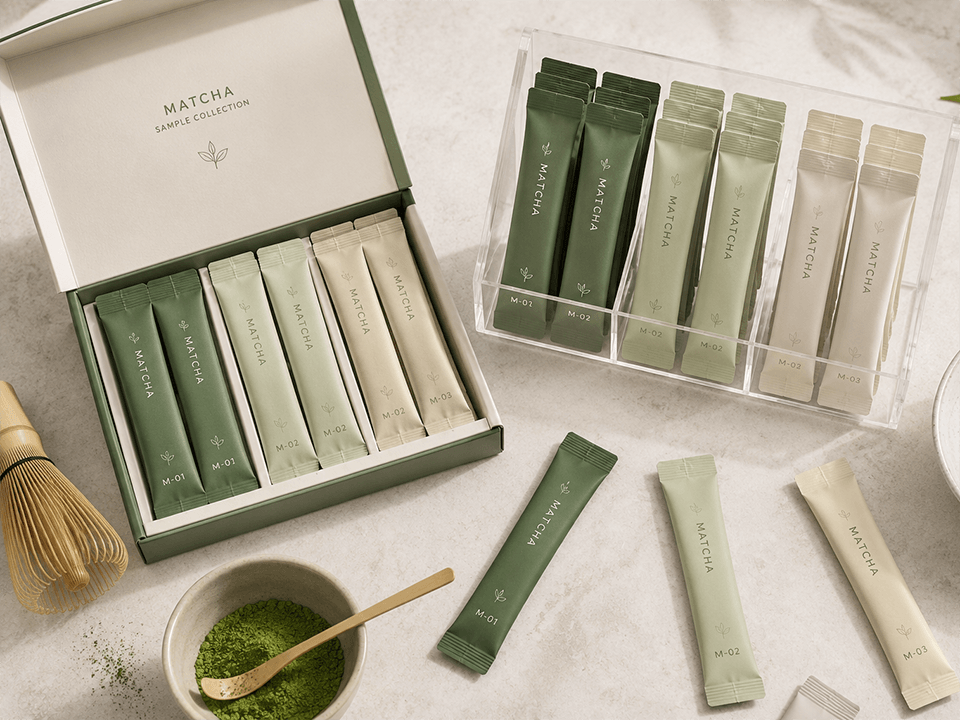
Each sample should be connected to a supplier product code. The supplier should also state whether the sample represents normal commercial production, a current production batch, pilot production or a specially prepared development blend.
The buyer should record the sample code, batch number where available, packing date, intended application, price, MOQ and available packaging.
A handwritten name such as “premium green” is not enough to support a future bulk order.
Define the Finished Product Before Testing
Testing should begin with a written product brief.
The brief should state whether the matcha will be used in water, milk, a flavored beverage, an instant sachet, bakery, chocolate, ice cream or another manufactured product.
It should also define the serving size, expected dosage, main ingredients, processing conditions and target selling price.
For a café drink, record the cup size, water volume, milk type, ice level and sweetness. For food manufacturing, record the full formula percentage, processing temperature and expected storage conditions.
Without this information, the evaluation can become a general tasting session that produces no clear commercial decision.
Commercial Matcha Sample Evaluation Framework
| Evaluation Area | What to Test | Why It Matters |
|---|---|---|
| Product identity | Product code, ingredient statement, batch and intended use | Ensures the selected sample can be ordered again |
| Dry appearance | Color, aroma, powder condition and visible clumping | Provides an initial quality and handling reference |
| Water preparation | Basic flavor, bitterness, astringency, aroma and texture | Reveals the matcha’s underlying sensory profile |
| Final application | Performance in the complete beverage or food formula | Shows what the customer will actually experience |
| Dosage range | Several measured matcha inclusion levels | Identifies the lowest effective commercial dosage |
| Color performance | Dry, prepared and finished-product appearance | Prevents decisions based only on powder color |
| Mixing and texture | Dispersion, clumping, mouthfeel and foam where relevant | Affects preparation speed and customer acceptance |
| Holding performance | Changes after a defined period | Important for takeaway, bottled and batch-prepared products |
| Processing performance | Effects of heat, freezing, acidity or fat | Required for manufactured food and beverages |
| Repeatability | Same test repeated by different people or on different days | Shows whether normal staff can reproduce the result |
| Cost in use | Price combined with effective dosage | Provides a more useful comparison than price per kilogram |
| Documentation | Specification, COA and commercial availability | Connects sensory approval with purchasing control |
Not every criterion needs equal importance.
For premium matcha prepared with water, aroma, mouthfeel and finish may receive the greatest weight. For a bakery product, heat performance, final color and cost at the required formula percentage may be more important.
Limit the Number of Samples
Testing too many samples at once can reduce the quality of the decision.
When ten or fifteen powders are compared in one session, sensory fatigue develops quickly and the differences become difficult to remember. Samples may also cool or separate while the panel works through them.
A focused comparison of three to five relevant options is usually easier to control.
The supplier should explain why each sample has been included. One may represent a smoother premium profile, another may offer stronger milk performance, and a third may prioritize cost efficiency.
This creates a meaningful commercial range rather than a random collection of grades.
When no sample reaches the required target, a second round can be requested with more specific feedback.
Assign Neutral Sample Codes
Brand names, prices and grade descriptions can influence judgment before tasting begins.
A sample described as ceremonial or premium may receive more favorable attention than a sample labeled culinary, even when the finished application performs similarly.
Assigning neutral codes such as A, B, C and D can reduce this bias during the first evaluation.
The person preparing the test can keep the key separately. Evaluators should record their observations before the sample identities and prices are revealed.
Blind testing does not remove all subjectivity, but it makes the first comparison more focused on actual performance.
Price can be introduced after the sensory and application results have been recorded.
Standardize Sample Storage and Handling
Samples should arrive in sealed, clearly identified packaging.
Before testing, they should be kept under the same conditions. A sample left open in a warm room should not be compared directly with a newly opened sample stored in protective packaging.
Storage temperature and time can influence matcha color and chemical stability. A controlled study found that measured brightness and green values declined more rapidly as storage temperature and duration increased.
All samples should therefore be handled consistently.
Open them as close as possible to the test session, reseal them promptly and avoid introducing moisture with wet spoons or equipment.
When refrigerated samples are used, keep the packages sealed while they return toward room temperature. This reduces the risk of condensation entering the powder when the package is opened.
The buyer should also note whether a sample arrives with hard clumps, damaged packaging, an unusual odor or signs of moisture exposure.
Use Accurate Weights Rather Than Spoons
Volume-based scoops are convenient for daily service, but they are less reliable for comparing samples.
Powders can differ in bulk density, flow and compaction. One level teaspoon may not contain the same weight from every sample.
Use a suitable digital scale and record the matcha weight in grams.
The water, milk, sweetener and other ingredients should also be measured consistently. Even a small change in milk or syrup can alter perceived bitterness, tea strength and color.
Commercial testing should create a repeatable formula that can later be transferred into a recipe card, product specification or manufacturing instruction.
Once the matcha has been selected, the business can decide whether a practical scoop provides acceptable accuracy in normal service.
Keep Preparation Variables Consistent
Matcha preparation can affect the sensory result.
A study found that different agitation rates and mixing times changed the measured aroma, bitterness, astringency and stability of prepared matcha. This supports the need to use the same mixing method for every sample during comparison.
The testing team should control the water temperature, liquid volume, matcha weight, mixing time, equipment and order of ingredient addition.
When using an electric frother or blender, use the same speed and duration. When whisking manually, the same trained person should prepare all coded samples during the first comparison.
A sample should not receive additional mixing simply because it initially appears more difficult to disperse.
That difficulty may itself be relevant to the commercial decision.
Inspect the Dry Powder Under Controlled Light
Dry inspection is useful, but it should remain an initial step rather than the final judgment.
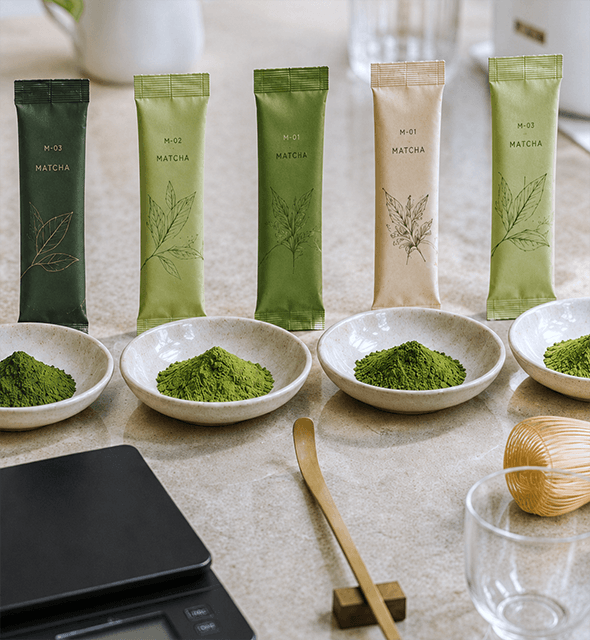
Place equal amounts of each sample in identical white or neutral containers. Compare them under the same natural or standardized light and avoid direct colored reflections from walls, packaging or clothing.
The buyer can observe green intensity, brightness, uniformity, visible fibers, clumping and powder condition.
Color is an important sensory and commercial attribute of matcha, and chlorophyll contributes to its characteristic green appearance. Research has also shown that matcha color indicators can be used as part of broader quality assessment.
However, color alone does not show whether the matcha will taste balanced, remain noticeable in milk or perform efficiently at the target dosage.
Camera photographs should be treated carefully. Automatic exposure, white balance, screen settings and compression can make one sample look brighter or darker than it appears in person.
Evaluate Dry Aroma
Smell each dry sample before adding water.
The aroma may be fresh, sweet, grassy, vegetal, marine, nutty, roasted or otherwise characteristic of the product. The buyer should also watch for stale, dusty, smoky, musty or packaging-related odors.
A weak dry aroma does not automatically make a sample unsuitable. Some matcha may express more aroma after preparation.
However, an obviously unpleasant or foreign odor should be investigated before further approval.
Use the same container size and sample quantity. Smell briefly and allow a pause between products to reduce sensory fatigue.
The description does not need to use highly specialized tea vocabulary. Terms that the business can apply consistently are more useful than elaborate notes that different evaluators interpret differently.
Prepare Every Sample in Water First
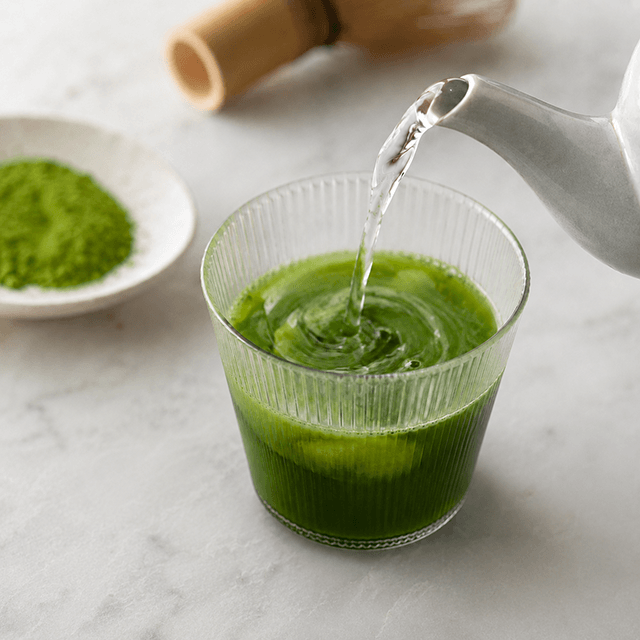
Even when the final product is a latte or food application, a controlled water preparation provides a useful baseline.
It exposes bitterness, astringency, aroma, mouthfeel and aftertaste without other ingredients hiding them.
The purpose is not necessarily to find the most pleasant pure-drinking sample. It is to understand the starting character of each powder.
A strong sample may taste more bitter in water but become balanced in milk. A delicate sample may taste excellent alone but disappear in the finished recipe.
Record the preparation conditions carefully. Every sample should use the same powder weight, water volume, temperature and mixing method.
Evaluate the drink while it is at a similar temperature, because cooling can change how aroma, bitterness and texture are perceived.
Separate Bitterness from Astringency
Bitterness and astringency are often confused.
Bitterness is a taste. Astringency is the drying or tightening sensation felt in the mouth after drinking.
A matcha can be moderately bitter without producing an unpleasant dry finish. Another can seem mild initially but leave strong astringency after swallowing.
This distinction matters in commercial products.
Some bitterness may help the matcha remain recognizable in milk or sweetened formulas. Excessive astringency can create a rough customer experience that requires additional sugar or fat to hide.
The evaluation form should record bitterness, astringency and aftertaste separately.
Evaluate Texture and Mouthfeel
A commercially useful matcha should produce a texture appropriate to the application.
For water preparation and lightly formulated drinks, the buyer should note smoothness, powderiness, coating sensation and any visible or perceived grit.
For lattes, evaluate whether the powder creates a pleasant body or leaves a chalky finish.
Particle characteristics can influence the physical and sensory behavior of tea powders, including wettability, suspension properties and rheology. Matcha sensory research also treats particle homogeneity as a relevant appearance and quality attribute.
The buyer should not approve a sample solely because a specification lists a fine particle size. The actual drink must still be tested using the planned equipment and formula.
A powder that performs well with an industrial blender may not disperse equally well with a handheld café frother.
Test Matcha in the Complete Final Application
The final application test should carry the greatest weight in a commercial evaluation.
A business selling oat milk lattes should test the samples in oat milk. A bakery should bake them. An ice cream manufacturer should evaluate the frozen product. A private label brand should prepare the matcha according to the instructions intended for the package.
The same matcha can produce very different results when milk, sugar, fat, fruit, flour or processing is introduced.
The goal is not to preserve the ranking established during water tasting. It is to determine which sample works best after all commercially relevant conditions are applied.
Application-Specific Matcha Tests
| Commercial Application | Variables to Control | What to Evaluate |
|---|---|---|
| Pure matcha | Powder weight, water temperature, water volume and whisking | Aroma, smoothness, bitterness, umami and finish |
| Dairy latte | Cup size, milk brand, milk temperature and sweetness | Tea intensity, color, balance and aftertaste |
| Plant-based latte | Exact milk formula, cup size and sweetener | Whether cereal, nut or coconut notes cover the matcha |
| Iced beverage | Ice weight, dilution, serving time and syrup | Flavor after dilution and visual performance |
| Flavored drink | Fruit, syrup, cream and acidity | Matcha recognition, color compatibility and balance |
| Instant sachet | Fixed fill weight, water volume and mixing instruction | Flavor at the final serving size and preparation ease |
| Ready-to-drink concept | Formula, homogenization, heat process and storage | Sediment, separation, flavor and color change |
| Bakery | Formula percentage, baking temperature and time | Baked color, flavor retention and bitterness |
| Ice cream | Complete mix, freezing method and storage | Frozen flavor, color, texture and aftertaste |
| Chocolate | Chocolate base, matcha percentage and tempering process | Flavor strength, color and powdery finish |
The intended customer should remain central to the decision.
A matcha expert may accept a stronger vegetal or bitter profile that mainstream café customers find difficult. A mass-market product may require greater accessibility, while a specialist tea brand may prioritize complexity and finish.
Test the Actual Milk You Plan to Use
Milk is not a neutral ingredient.
Dairy milk, oat milk, almond milk, soy milk and coconut milk can change the apparent sweetness, body, aroma and color of matcha.
Even products within the same category differ by manufacturer. One oat milk may be lightly flavored and relatively thin, while another may be sweet, creamy and strongly cereal-like.
A matcha selected with one milk brand may perform differently after the café changes suppliers.
The primary sample test should therefore use the intended milk. A secondary test can compare the most important alternative, especially when the menu offers both dairy and oat milk.
The buyer should determine whether one matcha works acceptably across both or whether the recipe needs a dosage adjustment.
Test Flavored Drinks as Complete Recipes
A sample that works in a plain latte may not remain noticeable in a strawberry, mango, vanilla or caramel drink.
Fruit, flavored syrups, cream toppings and cold foam can cover delicate tea aroma. Acidic ingredients can also change the sensory balance and visual appearance.
Prepare the complete drink rather than tasting the matcha base separately and assuming the result will transfer.
Layered beverages should be evaluated after mixing as well as immediately after preparation. The visual photograph may look attractive while the fully combined drink tastes weak or unbalanced.
The customer usually consumes more than the first unmixed layer.
Build a Dosage Ladder
A commercial sample should be tested at more than one dosage.
Begin around the planned recipe, then include a lower and higher level. For example, a café might compare 1.5, 2.0, 2.5 and 3.0 grams in the same drink formula.
The objective is to find the lowest dosage that consistently delivers the required result.
Testing only one dose can create a false comparison. A stronger matcha may be unnecessarily harsh at the same weight as a delicate sample but perform well at a lower level.
A weaker sample may appear affordable by kilogram but require substantially more powder.
Every dose should be weighed accurately and tested in an identical formula.
Calculate Cost in Use
The correct commercial comparison is usually cost per serving or finished unit, not price per kilogram.
Use the following calculation:
Matcha cost per serving = price per kilogram ÷ 1,000 × grams used
For example, a matcha priced at USD 60 per kilogram and used at 2.5 grams costs USD 0.15 per serving before freight and other purchasing costs.
A matcha priced at USD 48 per kilogram but used at 3.5 grams costs USD 0.168 per serving.
The second powder has a lower kilogram price but a higher ingredient cost in the finished drink.
For bakery, chocolate or ice cream, calculate the matcha cost using the inclusion percentage and actual production yield.
The calculation should use the dosage that passed the sensory and application test, not the dosage originally hoped for in the product brief.
Evaluate Dispersion Rather Than “Solubility”
Matcha does not behave like a fully soluble instant tea extract.
The powder is dispersed through the liquid, and some settling can occur over time. The relevant commercial question is whether the product disperses and remains acceptable under the intended preparation and serving conditions.
Observe whether the powder forms floating clumps, sticks to the bottom of the cup or requires excessive mixing.
The test should use normal equipment. A sample should not receive laboratory-level blending when the customer will only shake a sachet in a bottle.
For café applications, evaluate whether staff can prepare the drink within the required service time.
For consumer products, test the actual package directions with users who have not participated in product development.
Conduct a Holding Test
A drink that looks and tastes good immediately may change after ten, thirty or sixty minutes.
Holding tests are especially important for iced takeaway beverages, pre-batched café bases and ready-to-drink concepts.
Prepare each sample under identical conditions and observe it at predefined intervals. Record sedimentation, layer separation, foam loss, color change, flavor change and any increase in bitterness or dryness.
Do not automatically reject a matcha because some settling occurs. The acceptance level depends on the product.
A freshly whisked traditional drink is consumed quickly. A bottled beverage is expected to remain acceptable for much longer and requires a complete formulation and stability programme.
The sample test should reflect that difference.
Test Heat Performance
Matcha selected for bakery, pasteurized drinks or heat-processed food must be evaluated after heating.
Freshly mixed batter or beverage color does not predict the final product.
Record the oven or processing temperature, time, formula percentage and product thickness. A thin cookie may behave differently from a large cake, even when both use the same matcha percentage.
After processing, compare finished color, aroma, tea flavor, bitterness and aftertaste.
Allow the samples to cool under the same conditions before judging them.
When shelf life is important, repeat the evaluation after a defined storage period rather than approving the product directly from the production line.
Test Frozen Applications After Freezing
Ice cream, gelato and frozen desserts should be evaluated in their final frozen state.
Cold temperature can reduce perceived aroma and flavor intensity. Sweetness and fat can further soften or hide matcha characteristics.
A sample that tastes strong in the liquid base may become balanced after freezing. Another may disappear.
The evaluation should include color, flavor intensity, bitterness, texture and any powdery sensation.
Repeat the tasting after the product has been stored for the expected period, because freshly frozen and aged products may not provide the same experience.
Compare Finished Color, Not Just Powder Color
Dry powder color remains useful for quality control and marketing, but customers normally see the prepared product.
Milk lightens matcha. Flour, sugar, fat and chocolate change its visual expression. Heat and storage may further influence the result.
The buyer should therefore record color at three stages: dry powder, standard water preparation and final application.
Use identical cups, backgrounds and lighting. Photographs can support the record, but they should not replace direct observation.
When color is commercially critical, a business can establish a reference photograph or instrument-based range for the finished product. The reference should be created under controlled conditions and connected to the approved sample.
Repeat the Test on Another Day
A single tasting can be affected by fatigue, recent food, room conditions and preparation error.
The leading samples should be retested on another day using the same written method.
When possible, a second person should prepare the samples without revealing their identities.
The business can also ask another trained team member to reproduce the recipe. This helps determine whether the result depends too heavily on one evaluator or one preparation technique.
A sample that wins the first test but performs inconsistently during repeat testing may be less suitable than a slightly lower-scoring but more reliable alternative.
Include the People Who Will Use or Sell the Product
The testing team should reflect the commercial decision.
For a café, this may include the owner, product developer and barista. For a food manufacturer, it may include purchasing, research and development, quality and production. A private label brand may also include marketing when the product position and package instructions are being defined.
Too many untrained evaluators can create noise, but excluding the people responsible for production can create impractical decisions.
The product-development team may approve a recipe that is too slow or complicated for normal operations.
Every evaluator should use the same score definitions. Terms such as “strong,” “smooth” and “bright” should have a shared meaning within the project.
Use a Weighted Scorecard
Not every attribute should receive equal weight.
A premium water-drinking matcha may prioritize aroma, smoothness and finish. A flavored latte may prioritize matcha recognition, color and cost in use. A ready-to-drink product may place greater weight on processing and holding performance.
The scorecard should be created before the sample identities and prices are revealed.
Example Commercial Matcha Scorecard
| Evaluation Category | Suggested Weight | Scoring Question |
|---|---|---|
| Finished-product flavor | 20% | Does the matcha deliver the intended taste in the complete formula? |
| Tea intensity | 15% | Is the matcha recognizable at the target dosage? |
| Finished-product color | 15% | Does the application have the required natural green appearance? |
| Bitterness and astringency | 10% | Is the strength balanced rather than harsh or drying? |
| Texture and dispersion | 10% | Is the preparation acceptably smooth and easy to reproduce? |
| Processing or holding performance | 10% | Does the product remain acceptable under real conditions? |
| Dosage efficiency | 10% | What is the lowest dose that meets the standard? |
| Cost in use | 5% | Is the ingredient cost compatible with the product margin? |
| Commercial availability | 5% | Can the approved sample be supplied at the required volume and MOQ? |
| Total | 100% | Approve, retest or reject according to the project threshold |
A high total score should not automatically overcome a critical failure.
For example, a matcha may score well on flavor but remain commercially unsuitable when it is unavailable in the required volume or cannot meet a mandatory product specification.
The business can designate certain criteria as pass-or-fail before calculating the final score.
Reveal Price After the First Sensory Review
Price matters, but introducing it too early can distort evaluation.
A low-priced sample may be judged more generously, while an expensive sample may receive qualities that the evaluator expects rather than actually experiences.
Complete the initial sensory and application scoring before revealing the quotation.
Afterward, calculate cost per serving and review the commercial trade-offs.
The highest sensory score may not be the final choice when a nearby sample produces nearly the same customer experience at a substantially lower cost.
Similarly, the cheapest product should not be selected when it requires more powder, more sweetener or a reformulation that weakens the brand position.
Review the Specification and Documents Before Approval
Sensory success does not confirm food safety, regulatory suitability or commercial consistency.
Before final approval, the buyer should review the product specification, ingredient identity, packaging, storage instructions, shelf life and available batch documentation.
Testing requirements for pesticides, heavy metals and microbiology should be determined according to the destination market, customer requirements and product type.
The specification should describe the approved matcha well enough to support future orders. It may include the product code, sensory profile, color reference, moisture limit, particle-size reference, packaging format and relevant microbiological limits.
The buyer should also confirm whether the sample represents the same product code and production standard that will be supplied in bulk.
Retain an Approved Reference Sample
After selecting the matcha, keep part of the approved sample sealed and clearly labeled.
The record should include the supplier, product code, sample batch, approval date, preparation method, approved dosage and intended application.
The reference sample can be used when the commercial batch arrives.
Because stored matcha can change over time, the reference is not permanent. It should be protected carefully and interpreted together with photographs, scorecards and the written specification.
For longer projects, the supplier may also retain its own approved reference.
Both parties should agree that the sample is a commercial benchmark rather than relying on vague wording such as “same quality as before.”
Confirm Availability Before Completing the Decision
A sample should not be approved without confirming that the supplier can provide it at the required volume.
Ask whether the product is a standard grade, a limited lot or a custom blend. Confirm the MOQ, lead time, current stock and expected continuity for repeat orders.
A sample may perform perfectly but be unsuitable for a product launch when only a small quantity is available.
The supplier should also explain what happens when the current lot is exhausted. A blended commercial grade may offer stronger continuity, while a single-lot product may require new approval in the future.
The correct choice depends on the brand’s product story and supply requirements.
Use a Pilot Order Before Full-Scale Purchasing
A courier sample tests only a small amount of powder.
A pilot commercial order tests whether the supplier can reproduce the product, use the correct packaging, provide accurate documents and meet the agreed lead time.
When the pilot batch arrives, repeat the same application test used during sample approval.
Compare the finished color, flavor, texture and required dosage with the retained reference and evaluation records.
Minor natural variation does not automatically mean failure. The question is whether the batch remains within the commercially acceptable range.
Large-volume purchasing should begin only after the business is satisfied with both the matcha and the supplier’s execution.
Establish Incoming Batch Checks
Sample evaluation should become the foundation of an ongoing quality process.
For each new batch, confirm the product code, batch number, packaging condition and required documentation.
A quick sensory and application check can identify meaningful differences before the matcha enters full production or café distribution.
The test does not need to repeat the entire development programme for every delivery. It should focus on the attributes most important to the approved product.
When a deviation appears, place the material on hold and compare it with the specification and reference records before use.
The supplier should be informed with specific evidence rather than a general statement that the new batch “does not feel the same.”
Common Matcha Sample Evaluation Mistakes
Choosing by Dry Color Alone
A bright powder may still be weak, bitter or commercially inefficient in the final formula.
Finished-product testing should carry more weight than the dry appearance.
Comparing Samples Prepared Differently
Changing the water temperature, mixing time, milk or dosage makes the result unreliable.
Every relevant variable should remain consistent.
Approving Matcha Only in Water
Water preparation reveals the basic profile, but it cannot validate a latte, cookie, chocolate or ice cream product.
The final application must be tested.
Changing Several Variables at Once
When the matcha dose, milk and sweetener all change, the team cannot determine why one recipe performed better.
Change one main variable at a time.
Testing Too Many Samples
A large number of options creates fatigue and weakens the comparison.
Begin with a focused group of application-relevant products.
Selecting the Lowest Kilogram Price
Price per kilogram does not account for required dosage.
Calculate the matcha cost per serving or finished unit.
Using Unmeasured Spoons
Scoop volume can vary between powders and operators.
Development testing should use weight.
Ignoring Holding and Processing Conditions
A sample that performs well immediately may settle, fade or change after heat, freezing or storage.
Test the conditions the product will actually face.
Failing to Record the Method
Without a written recipe and evaluation form, the team may be unable to reproduce the test or explain the decision.
Approving a Sample Without a Product Code
The supplier needs a clear reference for bulk production.
A marketing grade name alone is not enough.
Skipping the Pilot Order
A small sample does not prove bulk consistency, packaging accuracy or export execution.
A pilot order reduces the risk before scaling.
Frequently Asked Questions
What Should I Look for When Evaluating Matcha Samples?
Evaluate product identity, dry condition, aroma, flavor, bitterness, astringency, texture, final-product color, dosage efficiency, mixing behavior, processing performance and cost in use.
The most important criteria depend on the intended application.
How Many Matcha Samples Should I Compare?
Three to five relevant samples are generally easier to compare effectively than a large number of unrelated grades.
A second round can be requested after the first evaluation narrows the required profile.
Should Matcha Be Tested Blind?
Neutral sample coding can reduce bias from grade names, supplier reputation and price.
The commercial details can be revealed after the first sensory scores have been recorded.
Should I Test Matcha with Water or Milk?
Use both when the product is intended for milk.
Water reveals the underlying sensory profile, while the final milk recipe shows commercial performance.
What Water Temperature Should Be Used?
Use the temperature that reflects the intended preparation method and keep it identical for every sample.
The objective is consistent comparison rather than finding a different ideal temperature for each powder during the first test.
How Do I Compare Matcha Color Accurately?
Use equal powder quantities, identical containers, neutral lighting and the same preparation formula.
Compare dry powder, water preparation and finished-product color separately.
Does Brighter Green Always Mean Better Matcha?
No.
Bright natural green can support product quality and customer appeal, but it does not prove superior flavor, milk performance, dosage efficiency or processing stability.
Why Does Matcha Taste Good in Water but Weak in Milk?
Milk adds volume, fat, sweetness and its own aroma, which can reduce perceived tea intensity.
The sample may be too delicate for the formula or may require a higher dosage.
How Do I Test Matcha for a Latte?
Use the actual cup size, milk brand, water volume, sweetener, ice and equipment planned for service.
Test several measured matcha dosages and calculate the cost per cup.
How Do I Test Matcha for Baking?
Use the complete recipe and normal production temperature and time.
Evaluate the finished product after cooling for baked color, tea flavor, bitterness and required inclusion percentage.
Should Matcha Settle in a Drink?
Some settling can occur because the powder is dispersed rather than fully dissolved.
The acceptable level depends on the product, serving time and customer expectation.
How Long Should a Holding Test Last?
Use intervals that reflect the product.
A café takeaway drink may be checked over thirty to sixty minutes, while a ready-to-drink product requires a formal stability and shelf-life programme.
How Can I Compare Matcha Prices Fairly?
Calculate the ingredient cost using the price per kilogram and the lowest dosage that meets the approved product standard.
Also consider packaging, freight, testing and expected waste.
Is Sensory Evaluation Enough to Approve Matcha?
No.
Sensory and application testing should be combined with product specifications, food-safety documentation, destination-market testing and supplier verification.
How Can I Make Sure the Bulk Order Matches the Sample?
Approve a coded sample, retain a reference, establish a written specification and repeat the same application test when the pilot or commercial batch arrives.
When Should a Matcha Sample Be Rejected?
Reject or request a replacement when the product identity is unclear, the sample has an abnormal odor or condition, it cannot meet the required application performance, its effective cost is unsuitable or the supplier cannot reproduce it commercially.
Final Thoughts
Commercial matcha sample evaluation should begin with the finished product rather than the sample bag.
The buyer must define the recipe, serving size, preparation method, processing conditions and acceptable cost before comparing powders.
Every sample should be coded, weighed accurately and tested under the same conditions. Dry appearance and water preparation provide useful baseline information, but the final application should determine the commercial decision.
The strongest matcha is not always the best option. The smoothest sample is not always the most efficient. The lowest-priced powder is not always the least expensive to use.
The right sample is the one that produces the intended flavor, color and texture at a repeatable dosage while fitting the product’s positioning, margin and supply requirements.
After approval, the result should be converted into a product code, specification, retained reference and pilot-order test.
That process turns a subjective tasting into a purchasing decision that can support consistent commercial production.
Evaluate Matcha Samples with TangMist
TangMist supplies bulk matcha powder for cafés, beverage brands, food manufacturers, distributors and private label projects.
Different matcha profiles can be compared for pure drinking, dairy and plant-based lattes, flavored beverages, single-serve sachets, bakery, ice cream, chocolate and other commercial applications.
Sample recommendations can be based on the intended formula, target dosage, finished-product color, tea intensity, bitterness, texture and target cost rather than grade names alone.
TangMist can also support commercial projects with product specifications, batch documentation, bulk packaging and private label options.
Request Commercial Matcha Samples
For an application-based recommendation, provide the intended product, serving size or formula percentage, main ingredients, preparation or processing method, destination market, packaging preference and estimated order quantity.
Contact TangMist to compare matcha samples under the conditions that matter to your finished product.