Sourcing matcha powder from China can be a practical option for B2B buyers who need stable supply, flexible pricing, OEM packaging, and export-ready documentation. For cafés, beverage brands, food manufacturers, distributors, supplement companies, and private label brands, the key is not simply finding the lowest price. The real work is choosing the right grade, verifying quality, checking documentation, and matching the powder to the final application.
China has a mature tea supply chain, strong food ingredient manufacturing capacity, and flexible private label support. For international buyers, this creates opportunities in bulk matcha powder, organic matcha, café-grade matcha, culinary matcha, flavored matcha, and matcha-based functional products.
This guide explains how to source matcha powder from China in a practical B2B way: what to check, what documents to request, how to compare grades, how MOQ and packaging affect price, and how to avoid common sourcing mistakes.
Why This Topic Matters for B2B Buyers
For B2B buyers, matcha sourcing affects more than product cost. It directly influences product consistency, color stability, shelf life, label claims, customer experience, and repeat order reliability.
A café needs matcha that performs well in milk-based drinks. A beverage brand may need a powder that disperses consistently in RTD or instant drink formulas. A private label brand may need retail packaging, barcode support, label review, and certification documents. A distributor needs stable supply, batch consistency, and clear export paperwork.
Organic buyers also need to be careful with certification and import requirements. For example, USDA states that organic products must be produced according to USDA organic standards, and organic labels need review and approval by a USDA-accredited certifying agent before marketplace use. For EU organic imports, the European Commission notes that imported organic products require the appropriate electronic certificate of inspection through TRACES.
In short, good sourcing protects your brand from four common risks:
- inconsistent matcha color or flavor between batches
- missing COA, pesticide, heavy metal, or microbiological reports
- wrong grade selection for the final application
- packaging or MOQ decisions that increase cost unnecessarily
Understanding Matcha Powder Sourcing from China
China as a Practical Matcha Supply Base
China has a long tea production history and a developed supply chain for green tea powder, matcha-style powder, organic tea ingredients, and food-grade powdered ingredients. For B2B buyers, the main advantages are flexibility, scalable production, and private label support.
Many international buyers source from China when they need:
- bulk matcha powder for beverage or food manufacturing
- cost-effective matcha for cafés and distributors
- organic matcha powder with export documents
- private label matcha pouches, tins, jars, or stick packs
- custom matcha blends for drinks, bakery, supplements, or wellness products
- OEM/ODM support for flavored matcha, instant matcha, and functional matcha formulas
However, not every supplier is suitable for every business model. A supplier that works well for 1 kg trial orders may not be the right partner for a 500 kg annual contract. A factory that can pack retail pouches may not have strong R&D support for instant drink formulas. This is why supplier evaluation should start with your application, not only the product name.
Matcha Powder vs Green Tea Powder
One important sourcing point is terminology. Some suppliers use “matcha” broadly, while others distinguish between ceremonial matcha, latte-grade matcha, culinary matcha, and green tea powder.
For B2B buyers, the difference matters because it affects color, aroma, bitterness, particle size, price, and label positioning.
Matcha is usually expected to have a finer texture, brighter green color, smoother taste, and better suspension than ordinary green tea powder. Green tea powder may still be useful for bakery, snack coating, or lower-cost food applications, but it may not deliver the same visual and sensory quality in premium drinks.
Start with the Final Application
Before asking for a quotation, define where the matcha will be used. This helps the supplier recommend the right grade and avoid overpaying.
For example:
- cafés usually need latte-grade matcha with good color and milk compatibility
- food manufacturers may need culinary matcha with stronger flavor and heat tolerance
- supplement brands may need clean documentation, fine mesh, and ingredient consistency
- private label retail brands may need attractive color, smooth taste, and stable packaging
- distributors may need several grades to cover different customer price points
A clear sourcing brief will lead to better samples, faster quotation, and fewer misunderstandings.
How to Evaluate a Matcha Powder Supplier in China
Check Whether the Supplier Understands B2B Applications
A serious B2B matcha supplier should not recommend the same grade for every buyer. The supplier should ask about your product format, market, packaging, price target, order volume, and document requirements.
For example, a matcha used in a premium café latte needs different sensory performance from a matcha used in biscuits or protein powder. A distributor may need multiple grades with different margins. A private label brand may need retail packaging and artwork support.
A good supplier should be able to explain:
- which grade fits your application
- how color and taste differ between grades
- whether the powder works in milk, bakery, RTD drinks, or sachets
- whether organic certification is available
- what documents can be provided before shipment
- whether private label packaging is available
- what MOQ applies to bulk powder and custom packaging
Review Factory Capabilities, Not Only Product Photos
Product photos are useful, but they do not prove supply capability. Ask about production process, grinding method, sieving, blending, packaging environment, batch control, and quality testing.
For B2B sourcing, useful questions include:
- Can the supplier provide batch-specific COA?
- Can they support repeat orders with stable color and taste?
- Do they offer sample-to-bulk comparison?
- Can they provide pesticide, heavy metal, and microbiological testing?
- Can they support OEM packaging and private label design?
- Can they handle export documents for your market?
- Can they recommend grades based on application instead of price only?
Ask for Real Samples Before Bulk Orders
Never place a bulk matcha order based only on photos, a short product description, or a low price. Matcha quality is highly visual and sensory. Color, aroma, bitterness, mouthfeel, and dispersibility are easier to judge through actual samples.
For sample testing, compare the powder in the same way your customers will use it. If you sell café drinks, test it with water and milk. If you manufacture bakery products, test it after heating. If you make sachets or instant drinks, test solubility, flavor balance, and powder flow.
Matcha Grade Selection for Different B2B Applications
Choosing the right grade is one of the most important sourcing decisions. Higher grade does not always mean better for every use. A ceremonial-style grade may be too expensive for bakery. A culinary grade may be too bitter for a premium café latte. A fine ingredient-grade powder may work well in supplements but not be ideal for a retail drinking product.
Ceremonial or Premium Drinking Grade
This grade is usually used for premium drinking, high-end retail products, specialty cafés, and gift sets. Buyers should look for bright green color, fine texture, smooth taste, low bitterness, and clean aroma.
It is suitable for:
- premium private label matcha
- direct-to-consumer retail tins
- specialty café menus
- high-end matcha gift products
The main sourcing challenge is price stability. Premium grades are more sensitive to harvest quality, raw leaf selection, and storage conditions.
Latte Grade Matcha
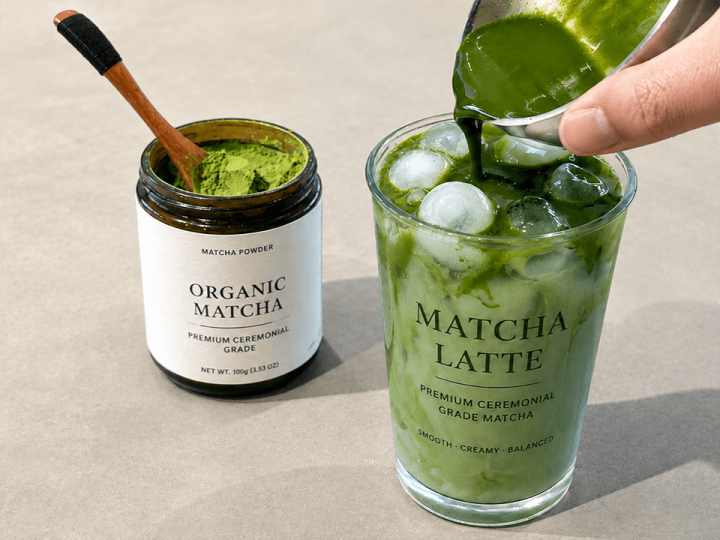
Latte grade is often the most practical choice for cafés, coffee chains, beverage distributors, and foodservice buyers. It should maintain a good green color in milk and have enough flavor strength to stand out in lattes, smoothies, frappes, and iced drinks.
It is suitable for:
- matcha latte
- iced matcha drinks
- café chains
- foodservice supply
- bubble tea and dessert drinks
The key is balance. The powder should not be too bitter, but it must still have enough body when mixed with milk, oat milk, or sweeteners.
Culinary Matcha
Culinary matcha is designed for food processing and recipe applications. It may have a stronger taste and a more cost-effective price.
It is suitable for:
- bakery
- ice cream
- chocolate
- cookies
- sauces
- dessert mixes
- snack coatings
For this grade, buyers should focus on color after processing, flavor strength, particle size, and cost per finished serving.
Ingredient Grade for Supplements and Functional Foods
Ingredient-grade matcha is often used in powders, capsules, superfood blends, greens powders, and wellness formulas. The focus is usually documentation, consistency, mesh size, contaminant testing, and compatibility with other ingredients.
For supplement and functional food brands, avoid medical-style claims. Matcha can be positioned as a tea-based ingredient, clean label flavor component, natural green color contributor, or plant-based functional ingredient, depending on local regulations.
Practical Table: Application vs Recommended Matcha Grade
| B2B Application | Recommended Grade | Key Buying Focus | Common Packaging | Notes for Buyers |
|---|---|---|---|---|
| Specialty café drinks | Latte grade or premium drinking grade | Color in milk, smooth taste, low bitterness | 500 g, 1 kg, 5 kg bags | Test with dairy and oat milk before bulk order |
| Retail private label tins | Ceremonial or premium grade | Bright color, aroma, fine texture, premium appearance | 30 g, 50 g, 100 g tins | Check shelf life, oxygen barrier, and label claims |
| Bubble tea / drink chains | Latte grade | Flavor strength, cost per cup, consistency | 1 kg, 5 kg, 10 kg bags | Choose stable grade for repeat purchase |
| Bakery and desserts | Culinary grade | Heat performance, color retention, flavor strength | 5 kg, 10 kg, 20 kg cartons | Test after baking or processing |
| RTD or instant drinks | Fine latte or ingredient grade | Dispersibility, taste, blending compatibility | Bulk bags or stick packs | Ask about mesh size and blending support |
| Supplements / greens powder | Ingredient grade or organic matcha | COA, heavy metals, pesticide testing, mesh | 10 kg, 20 kg cartons | Confirm market-specific documentation |
| Distributors / wholesalers | Multiple grades | Price ladder, stable supply, clear specs | 1 kg to 20 kg bulk formats | Offer several grades for different customer needs |
MOQ, Price, and Packaging Considerations
Bulk Matcha MOQ
MOQ depends on grade, packaging format, and whether the product is standard bulk powder or custom private label packaging.
Typical sourcing logic:
- bulk powder usually has lower MOQ
- custom retail pouches or tins require higher MOQ
- stick packs require higher MOQ because of packaging setup
- organic matcha may require separate batch and documentation checks
- custom blends may require R&D and trial production
For early-stage brands, it is often better to start with bulk powder or simple private label packaging before moving into complex custom tins, sachets, or multi-SKU product lines.
What Affects Matcha Powder Price?
Matcha price is influenced by:
- raw leaf quality
- origin and harvest season
- shade-growing and processing method
- grinding fineness
- color and taste profile
- organic certification
- testing requirements
- order quantity
- packaging format
- private label design and printing
- international shipping method
A low price can be attractive, but it may also indicate lower color quality, stronger bitterness, poor aroma, ordinary green tea powder, or weak batch control.
Packaging Options for B2B Buyers
Packaging affects shelf life, brand positioning, MOQ, and landed cost. Matcha is sensitive to light, oxygen, heat, and moisture, so packaging should protect freshness.
Common packaging formats include:
Bulk Packaging
Bulk packaging is suitable for manufacturers, cafés, distributors, and repackers. It is usually more cost-effective and easier to scale.
Common options:
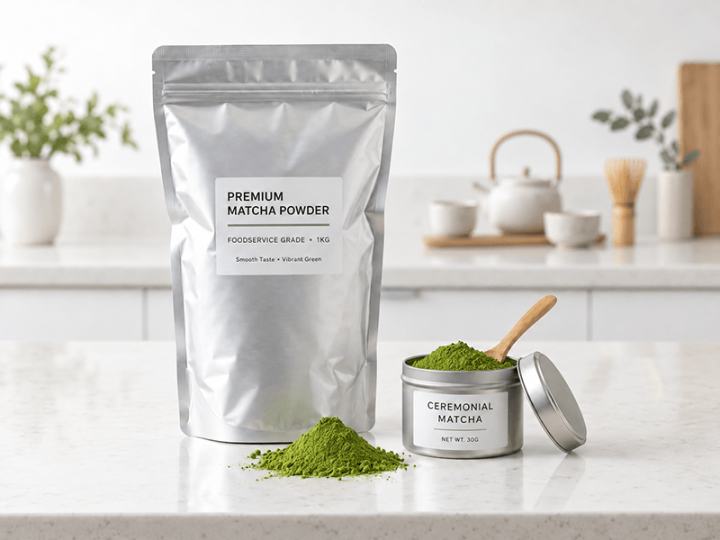
- 1 kg aluminum foil bags
- 5 kg bags
- 10 kg cartons
- 20 kg cartons
Private Label Retail Packaging
Retail packaging is suitable for e-commerce brands, organic food brands, wellness brands, and specialty tea brands.
Common options:
- stand-up pouches
- flat-bottom pouches
- tins
- jars
- paper tubes
- single-serving sachets
Stick Packs and Sachets
Stick packs are useful for convenience products, travel packs, café sampling, and subscription boxes. However, they usually require higher MOQ and more packaging planning.
Documentation Buyers Should Request Before Ordering
For international matcha sourcing, documents are just as important as samples. A good supplier should be able to provide clear documentation based on your market and product positioning.
Core Document Checklist
| Document | Why It Matters | When to Request |
|---|---|---|
| Product Specification | Confirms grade, appearance, taste, mesh, moisture, shelf life, storage | Before sample approval |
| COA | Shows batch test results such as moisture, ash, microbiology, heavy metals, or pesticide data | Before bulk shipment |
| Pesticide Residue Test | Important for tea products and organic or EU-focused projects | Before import or retail launch |
| Heavy Metal Test | Helps assess lead, arsenic, cadmium, and mercury risk | Before bulk purchase |
| Microbiological Test | Confirms food safety indicators such as total plate count, yeast, mold, E. coli, Salmonella | Before shipment |
| Organic Certificate | Needed if selling as organic in regulated markets | Before label design and import |
| HACCP / ISO / GMP Documents | Supports supplier qualification and buyer audits | During supplier evaluation |
| MSDS / SDS | Useful for logistics and internal ingredient review | Before shipping |
| Allergen Statement | Helps food brands and manufacturers review label compliance | During product development |
| Non-GMO / Vegan Statement | Useful for clean label and wellness products | When required by market |
For organic projects, buyers should confirm whether certification applies to the raw material, the processing facility, and the final packaging process. Organic labeling requirements vary by market, so final label claims should be reviewed according to the destination country’s rules. USDA organic labeling requires review and approval by a USDA-accredited certifying agent before marketplace use.
Supplier Evaluation Checklist for China Matcha Sourcing
Use this checklist before placing a bulk order.
Product and Grade
- Does the supplier offer different grades for different applications?
- Can they explain the difference between ceremonial, latte, culinary, and ingredient grades?
- Can they provide physical samples before bulk production?
- Can they match sample quality in bulk shipment?
- Can they provide color, taste, mesh, and moisture specifications?
Quality and Testing
- Is a batch-specific COA available?
- Are heavy metals tested?
- Are pesticide residues tested when required?
- Are microbiological indicators tested?
- Can the supplier provide recent test reports instead of outdated documents?
- Are testing methods or third-party lab details available?
Certifications and Export Documents
- Is organic certification available if needed?
- Can the supplier provide HACCP, ISO, GMP, Halal, Kosher, or other documents if applicable?
- Can they support export documents for your destination market?
- Are label claims reviewed carefully before printing?
OEM and Private Label Support
- Can the supplier support private label packaging?
- What packaging formats are available?
- What is the MOQ for each packaging type?
- Can they help with artwork layout or label information?
- Can they support custom blends or flavored matcha?
Commercial Terms
- What is the MOQ for sample, trial, and bulk orders?
- What is included in the quotation?
- Is the price EXW, FOB, CIF, DDP, or another term?
- What is the lead time for bulk powder and custom packaging?
- How is quality confirmed before shipment?
Common Mistakes to Avoid
Choosing the Cheapest Matcha Without Testing
The cheapest option may work for some industrial applications, but it is risky for cafés, retail brands, and premium drinks. Poor color, bitterness, weak aroma, or coarse texture can damage customer perception.
Always test samples in the final application before confirming the grade.
Using One Grade for Every Product
A common mistake is using the same matcha for latte, bakery, supplements, and retail tins. Each application has different requirements. A bakery matcha needs heat performance. A café matcha needs milk compatibility. A private label drinking matcha needs smooth taste and attractive color.
Ignoring Documentation Until the Order Is Ready
Documents should be discussed early, not after production. If your market requires organic documents, pesticide testing, heavy metal testing, or special import paperwork, confirm this before placing the order.
Overlooking Packaging MOQ
Custom packaging can significantly change MOQ and lead time. Tins, printed pouches, jars, and stick packs may require separate packaging production. For new brands, starting with simpler packaging can reduce risk.
Not Comparing Sample and Bulk Batch
A good sample does not automatically guarantee that the bulk batch will be identical. Ask how the supplier controls batch consistency and whether pre-shipment samples or batch photos can be provided.
Making Overly Strong Health Claims
Matcha can be positioned as a tea ingredient, clean label beverage ingredient, or functional food component. However, avoid medical or disease-related claims, especially for supplements, wellness products, or export markets. Claims should be reviewed according to local regulations.
How MatchaOEMFactory Supports This Need
MatchaOEMFactory supports B2B buyers who need reliable matcha powder sourcing from China, bulk supply, private label packaging, and application-based grade selection.
We work with cafés, beverage brands, food manufacturers, distributors, importers, private label brands, supplement companies, and e-commerce sellers that need practical sourcing support rather than generic product listings.
Our support can include:
- bulk matcha powder supply for food, beverage, and wellness applications
- grade comparison for ceremonial, latte, culinary, and ingredient-grade matcha
- private label packaging for pouches, tins, jars, cartons, and sachets
- OEM/ODM support for flavored matcha, instant matcha, and matcha blends
- sample preparation for application testing
- COA and specification support
- organic and export documentation support when available
- packaging and MOQ guidance for new product launches
- sourcing support for cafés, distributors, importers, and brand owners
The goal is to help buyers select the right matcha for their product, not simply purchase the highest or lowest grade.
FAQ
Can I source organic matcha powder from China?
Yes, organic matcha powder can be sourced from China, but buyers should carefully verify the certificate, certified scope, processing facility, and import requirements for the destination market. For EU organic imports, the European Commission states that imported organic products require the appropriate electronic certificate of inspection through TRACES.
What is the best matcha grade for cafés?
For cafés, latte grade is usually the most practical choice. It should have good green color, smooth taste, and enough flavor strength to work with milk, oat milk, syrups, and iced drinks. Premium drinking grade can be used for higher-end menus.
What documents should I request from a China matcha supplier?
At minimum, request a product specification, COA, heavy metal test, microbiological test, pesticide residue test when needed, shelf life information, storage instructions, and certification documents if you plan to sell organic or private label products.
What is the MOQ for private label matcha?
MOQ depends on the packaging format. Bulk powder usually has lower MOQ, while printed pouches, tins, jars, and stick packs require higher MOQ because of packaging production and setup costs. It is best to confirm MOQ separately for powder and packaging.
Can matcha powder be used in supplements or functional foods?
Yes, matcha powder can be used in greens powders, capsules, wellness blends, and functional drink formulas. However, it should be positioned carefully as a tea-based ingredient or plant-based food ingredient. Avoid medical claims unless reviewed by qualified regulatory professionals in your market.
How do I know if a matcha sample is suitable for my product?
Test the sample in the real application. For cafés, test it in hot and iced lattes. For bakery, test after heating. For supplements, check blending behavior, color, taste compatibility, and documentation. For private label retail, evaluate color, aroma, mouthfeel, and packaging stability.
Ready to Source Matcha Powder from China?
If you are developing a matcha product, building a private label brand, sourcing for cafés, or comparing bulk matcha grades for manufacturing, the best next step is to test the right samples and review the documents early.
Contact TangMist and we will assist you in comparing matcha grades, discussing minimum order quantities, selecting packaging, reviewing required documents, and preparing a customized quote based on your market and application needs.